

New York Commercial Real Estate | 5 minute read
How to Build Property Owner Lists: Steps, Pro Tips & What to Avoid
By Laura Pop-Badiu | Dec 11, 2025
In this guide, we’ll walk you step by step through how to build property owner lists inside the PropertyShark platform, how to customize them for your goals and how to avoid common mistakes.
For real estate professionals, finding the right lead at the right time can make or break a deal and property lists can significantly speed up the lead generation process. Whether you’re an investor looking for motivated sellers or an agent prospecting new listings, learning how to build property owner lists will help you avoid chasing scattered information and instead, work more efficiently and save valuable time.
By including property owner lists in your strategy, you can find more leads faster, organize them based on your goals and narrow your outreach to the owners most likely to respond. As a result, you’ll have better chances of closing deals.
In this article, we’ll guide you step by step on how to build property owner lists with PropertyShark, how to customize them for your goals and how to avoid common errors.
What Is a Property Owner List?
A property owner list is a customized list of properties grouped around a shared characteristic such as location, ownership type, property condition, etc., along with the names and contact information of their real owners.
These lists are commonly used in real estate to identify:
- motivated sellers
- absentee owners
- landlords
- distressed property owners
- owners in specific neighborhoods, building types or value ranges.
Overall, property lists help you quickly identify the owners who match your investment or outreach strategy, making it easier to contact the right person and save time.
Types of Property Owner Lists
Depending on your goals, you can build owner lists based on dozens of criteria with PropertyShark. Here are some of the most common and most effective groupings:
1. Absentee owners
This refers to owners who do not live at the property in question, often landlords or investors.
Property lists with absentee owners are especially valuable for wholesalers, agents and flippers looking for investment opportunities, whether it’s a potential flip or a property priced below market value.
2. Distressed property owners
These property lists typically include owners with properties that have lis pendens, Notices of Default (NODs) and foreclosure filings. They are of interest to investors seeking motivated sellers or to buyers willing to participate in auctions to pick up properties at lower prices.
3. Recent buyers or long-term owners
This category includes owners who either bought a property within the last few years or have held it for a long period of time. Property lists focused on such owners is useful for agents looking for future listings, appraisers seeking reliable comparables and investors exploring off-market opportunities where long-term equity or recent life changes may motivate a sale.
4. Specific property attributes
This applies to owner lists built around particular building features such as property size, value, age or building class in an effort to target a narrowly defined asset type. Lists based on these custom or more niched criteria is useful for developers, commercial investors, brokers and appraisers who are looking for highly specific properties or granular data for targeted outreach and market analysis.
5. Geographic filters
This refers to owner lists built by narrowing properties to a specific area, whether by neighborhood, zip code, borough or even block and lot. Such hyper-targeted lists are essential for agents focused on specific areas, investors sourcing opportunities in defined markets and brokers in need of relevant, localized comparables.
6. Conversion potential
Commercial properties can also be grouped by their potential to be converted to residential units. For NYC real estate, PropertyShark uses the Conversion Feasibility Index, a proprietary indicator that assigns scores to commercial buildings based on their conversion potential, with the highest scores indicating the most attractive opportunities. Such property lists can be highly useful for investors looking to develop housing units through the adaptive reuse of commercial properties rather than building them from the ground up.
All these lists and more can be created using PropertyShark tools like Property Lists and Property Search.
Why Build Your Own Owner List vs. Buying a Pre-Made List?
When it comes to lead generation, you can either buy pre-made owner lists or build your own. Both approaches have advantages, depending on the use case, goals and budget.
Buying Pre-Made Lists
Pros:
- Fast access
- No setup required
Cons:
- Data may be outdated, incomplete or inaccurate
- Often expensive, especially if purchased repeatedly
- Little control over who gets included
- High chance of duplicate or irrelevant leads
Building Your Own List
Pros:
- Fully customizable to your strategy
- Targeting by specific criteria such as property type, size, location, distress level and more
- Pulls from fresh, verified public records
- Cleaner, higher-quality leads
- More cost-effective in the long run
Cons:
- Requires a short setup
- Access to full owner information requires a paid PropertyShark account (however, the search tool can still be previewed for free).
Bottom Line
While buying lists is certainly more efficient when trying to quickly close a deal, building your own lists delivers more accurate, relevant and actionable leads, ultimately supporting stronger chances of closing deals.
How to Build Property Owner Lists Step-by-Step with PropertyShark
Note: Owner names, contact details and full results require a paid PropertyShark subscription, but you can still preview the search tool for free: https://www.propertyshark.com/Property-Search/.
Use Case 1: Build an Absentee Owner List in a Specific Neighborhood
Goal: Find owners who do not reside at the property in order to find strongly motivated sellers.
Steps:
- Go to PropertyShark’s Property Lists tool
- Select your location (example: DUMBO, Brooklyn)
- In the Owner dropdown, select Non-Owner Occupied (Absentee). You can also choose between in-state and out-of-state owners, as well as individual owners or corporate entities.

- Add additional filters if needed, such as year built, building class, property value range and more.
- Click Search, then review all absentee-owned properties in your results.
- Select the properties that you want to include in your final list.
- Click Export to download the list with owner names and addresses. (Note: Exports are only available to paid users).
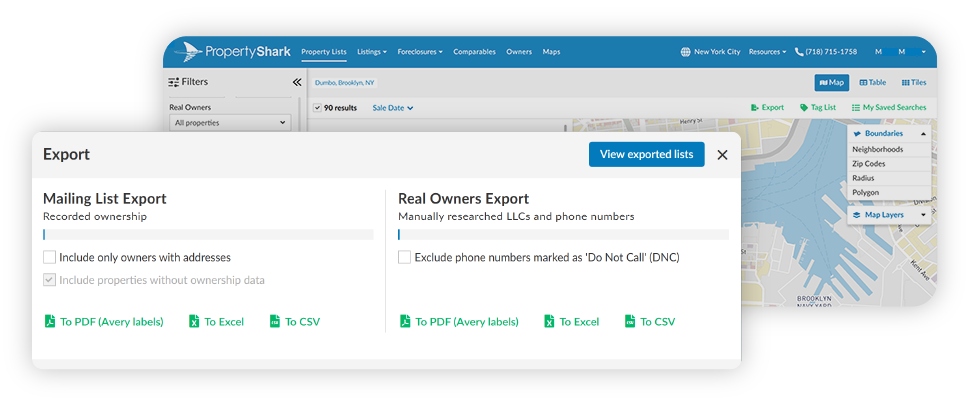
Use Case 2: Build a Distressed Owners List
Goal: Identify pre-foreclosure or foreclosure property owners who are more likely to sell or more likely to sell at below market-rate prices.
Steps:
- Go to the dedicated Foreclosures section.
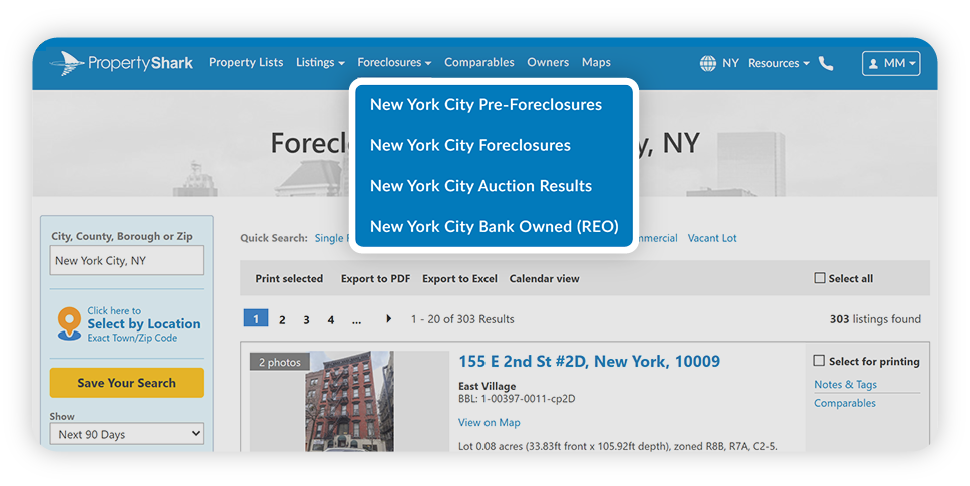
- Filter by:
- Date added
- Date of auction
- Neighborhood
- Zip code
Keep in mind that given the specific attributes of foreclosed properties, the filters on the Foreclosure search page are different than criteria available on the Property List search page.
- Add additional property-level filters like number of units, year built, square footage, etc.
- Review owner details on each record.
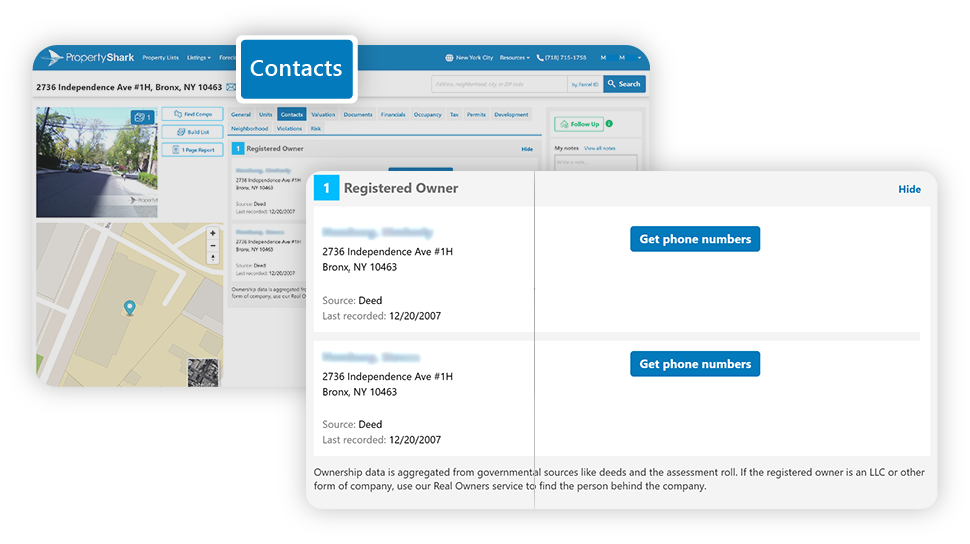
- Select the properties that you want in your final list and then export the list.
Use Case 3: Build a Targeted List Based on Property Attributes
Goal: Ideal for agents, developers or commercial investors looking for properties that meet very specific criteria.
Steps:
- Start a Property Search.
- You can apply filters for property type, square footage, lot size, units, year built, loans and more.
- Combine with owner filters like absentee owners or institutional owners.
- Sort results by criteria like unused FAR, sale date, sale price, etc.
- Select all properties you want to include in your final list.
- Export your custom list.

Build and export owner lists with the Property Lists tool.
Pro Tips for Success & Errors to Avoid
Pro Tips
- Stack filters (e.g. absentee owners combined with certain building sizes) for ultra-targeted lists.
- Use zoning and building class filters to avoid irrelevant properties.
- Save searches so you can rerun them at your desired frequency.
Avoid These Mistakes
- Don’t contact every owner on a list. Instead, use segmentation.
- Don’t rely solely on purchased lists as they age quickly.
- Don’t skip property details like year built, building class and others when refining your targeting.
- Don’t contact distressed owners without verifying records. Keep in mind that filings can change.
Final Thoughts
Learning how to build property owner lists is one of the fastest, most effective ways to generate high-quality real estate leads. With PropertyShark’s powerful data tools and filters, you can create accurate, customizable and hyper-targeted lists for any strategy, from absentee owners to distressed sellers and tightly defined investment niches.
Start building your customized owner lists today using the free tool preview.
Access comprehensive property data and ownership information with intuitive research tools.


Laura Pop-Badiu is a Senior Creative Writer at PropertyShark, with a degree in Journalism and a background in both hospitality and real estate. Laura is a certified bookworm with a genuine passion for the written word and a keen interest in the real estate market, having previously written for Yardi's RentCafe, CoworkingCafe and CoworkingMag. Her work has been featured in major publications like The New York Times, Forbes, NBC News, The Business Journals, Chicago Tribune, MSN and Yahoo! Finance, among others.
Recent Reports

2026 Q3 Foreclosure Report: NYC Foreclosure Activity Slows to 4-Year Low, Fueled by Queens & Brooklyn Contractions
NYC foreclosures contracted to levels not seen since late 2022, fueled by drops in Brooklyn and Queens. Meanwhile, elevated activity in the Bronx kept it near the forefront, surpassed only by Queens.

Atherton Breaks $10M Median as 11 States Set New Price Records
2026 brought record price peaks to 11 states, including the first ever eight-figure median sale price with Atherton’s dramatic surge back to #1. Meanwhile, California’s presence continued to shrink with the pullback of the Bay Area, although it remained home to more than half of the country’s top zips, while the New York metro supplied one quarter, its strongest presence yet.

NYC Homeownership by the Numbers: How Household Type, Gender & Age Shape Who Owns in Every Neighborhood
In a city where homeownership is dominated by married-couple families, Manhattan stands as the only borough led by nonfamily owners. At the same time, residents younger than 35 make up less than one tenth of the ownership pool and female-led family households outnumber male-led families across 91% of NYC neighborhoods.