
New York Real Estate | 7 minute read
How to Find Rent-Stabilized, Rent-Controlled or Rent-Regulated Apartments in NYC
By Laura Pop-Badiu | Oct 6, 2026
In NYC, rent-regulated apartments are of high-interest for investors, brokers and other real estate professionals. In this guide, you will learn how to find rent-stabilized and rent-controlled apartments in NYC, through the new PropertyShark features.
For brokers, investors and other NYC real estate professionals, rent-regulated apartments remain a high-interest asset, since regulation can affect pricing, underwriting, financing and exit strategies. Plus, rent-regulated inventory makes up a major share of the NYC rental stock, with almost half of all rental apartments rent regulated.
If you are wondering how to find rent-stabilized apartments in NYC, the relevant clues are usually spread across multiple public sources and, most of the time, official building lists are not fully comprehensive. PropertyShark’s new NYC rent regulation features are built for this exact workflow, with full, citywide coverage, new tax benefit visibility and dedicated filters that make these properties far easier to identify at scale.
Before we break down the new PropertyShark features and how to use them to uncover rent-regulated apartments in NYC, let’s go through what exact characteristics define these types of properties.
What Rent-Regulated, Rent-Stabilized and Rent-Controlled Apartments Mean
In NYC, rent regulated is a broad umbrella term that includes both rent stabilization and rent control. It’s important to note that these are not interchangeable categories, even though they are often used that way in everyday conversation.
A rent-stabilized apartment is defined by the cap in rent increase, which can go up by a maximum of 3% on a one-year lease and 4.5% for a two-year lease. This protects tenants from unexpected rent spikes and unjustified evictions, while also prioritizing them for lease renewals. Rent stabilized is the larger and more common category, which generally covers apartments in properties built between 1947 and 1974, typically with six or more units.
Learning how to find rent-stabilized apartments in NYC means searching for specific buildings first, then checking which units are actually rent stabilized, since not every apartment in that building will be necessarily rent stabilized.
Rent-controlled apartments are generally located in buildings built before February 1, 1947, where the tenant or lawful successor has been in continuous occupancy since before July 1, 1971. Rent increases in rent-controlled apartments are constricted by government-mandated caps and are typically set according to inflation.
Like with rent-stabilized apartments, rent-controlled ones also protect tenants from unruly eviction. However, rent-controlled apartments make up for a very small share of NYC housing and can transition to rent stabilized if the tenant moves or passes away.
That distinction matters for anyone researching how to find rent-stabilized or rent-controlled apartments in NYC. Rent regulated tells you the property is in the broader regulated pool; rent stabilized and rent controlled tell you which system may apply and what kind of follow-up diligence is needed.
Why the New PropertyShark Features Matter
One reason finding rent-regulated apartments has been a frustrating research task is that there is no single official source: The Rent Guidelines Board’s building list is not comprehensive and does not identify which specific units are stabilized. That is exactly why the new PropertyShark features matter: They turn a scattered research process into a targeted property search.
For professionals researching how to find rent-regulated apartments in NYC, the key is the ability to search this inventory directly using dedicated filters, then move from those results into the full property record. PropertyShark’s property reports combine verified public record data, deed filings and market insights in one place, while the property lists tool and ownership reports let users move quickly from identification to underwriting and outreach.
The new tax benefit feature is especially useful in NYC because some apartments are regulated through tax benefit programs rather than only through age and unit-count rules. New York State’s Division of Housing and Community Renewal (DHCR) states that rent stabilization can apply to buildings receiving J-51, 421-a and 421-g benefits, meant to lower property taxes for building owners as long as they create or preserve rent-stabilized apartments. In practice, that means the tax benefit field can help users flag buildings where regulation may not be obvious from a quick age –and units screening alone.
In other words, how to find rent-stabilized apartments in NYC is no longer just a matter of cross-checking scattered lists and tax records one by one. This is why the new PropertyShark filters were developed, to create a much more direct starting point. Users with an active PropertyShark subscription can access the full feature pack, including the new rent-regulated filters.
How to Use the New PropertyShark Filters to Find Rent-Regulated Apartments in NYC
When browsing NYC properties on PropertyShark, these are the exact steps that you want to follow to find rent-stabilized or rent-controlled apartments:
1. Start the search by entering the address, neighborhood or zip code of your choice
2. Use the filters in the left menu to select the property characteristics that will narrow down your search, whether that is property type, size, number of units, zoning, loan, tax or distress information
3. Open the Units filter and select the desired rent regulation status, stabilized or controlled
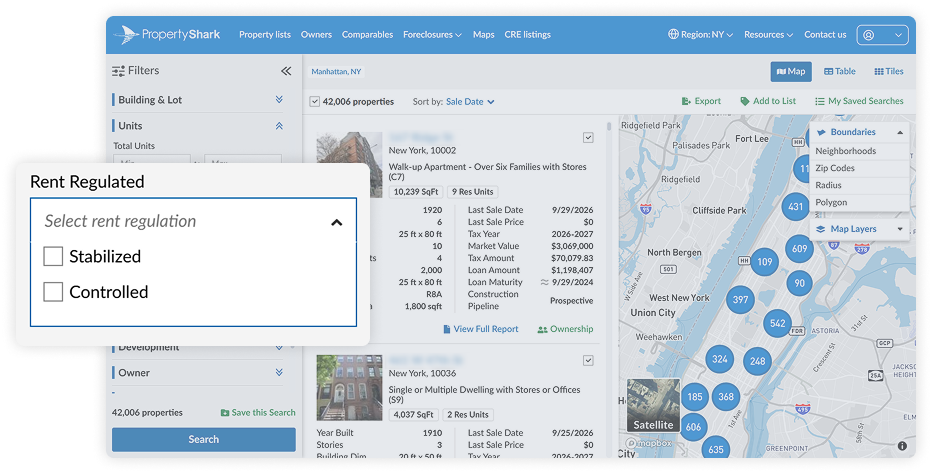
4. Browse through the list of results and keep in mind that while the buildings contain rent-regulated units, that doesn’t mean that every unit in said building is regulated
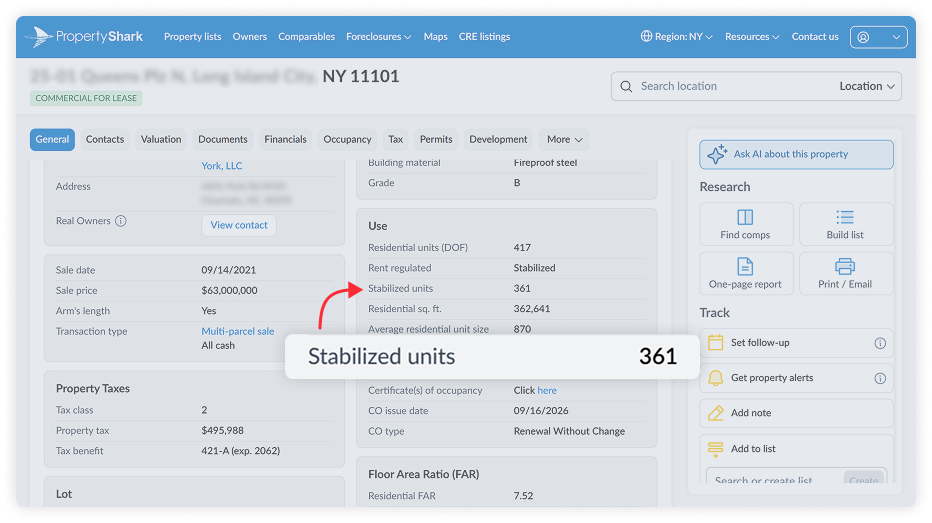
5. Once you open a full property report, you can review the Use section under the General tab, where the total number of units within the building is listed, along with the number of rent-stabilized ones
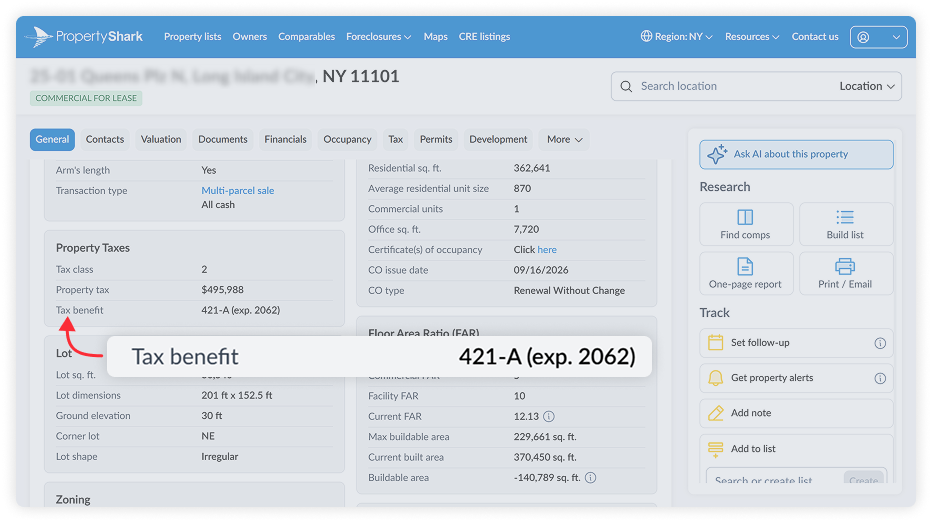
6. Check the Property Taxes section under the General tab to look for any active tax exemptions. The tax benefit, which includes the expiration year, refers to properties with stabilized units but also an active tax exemption. Keep in mind that, once the tax benefit expires, the rent-regulated units can revert to market rate, which is exactly why knowing the duration of the exemption is important
What to Do Once You Find a Property
Once you identify a building with regulated apartments, these are the next steps that will help guide your decision further:
Start by identifying the owner
PropertyShark’s ownership information under the Contacts tab in the full property report show the registered owner and — depending on subscription — contact details. For brokers and investors, that makes off-market outreach more practical, especially when the owner is an individual or a smaller operator rather than a large institutional holder.
Check the owners’ portfolio
PropertyShark’s deep owner search function can show other properties currently or previously tied to the same owner, including affiliated holdings through companies. That matters because a landlord with one regulated building may be a more realistic seller than one assembling or actively holding a larger regulated portfolio.
Review debt and lien position
Property reports include mortgage summary data and pull together recorded documents and title history. For regulated buildings, that can help surface stress points, such as heavier leverage, layered debt or other recorded encumbrances, that may affect seller motivation and acquisition timing.
Look at the sale history
PropertyShark’s Valuation section documents the last sale of each property, including the sale price, transaction type and recordation dates, along with the assessment history. That gives buyers a cleaner view of what the current owner may have paid, how long they have held the asset and whether there may be room to sell at current pricing levels.
Confirm unit-level status before you underwrite too far
The only way to know whether a specific apartment is rent stabilized is to contact DHCR. Building-level filters are an excellent sourcing tool, but final diligence still needs a unit-level check.
Conclusion
NYC rent regulation is a framework that includes both rent stabilization and rent control, with important differences in coverage, economics and diligence. For real estate professionals, that is exactly where real estate intelligence platforms can make a difference.
If you are interested in learning how to find rent-regulated apartments in NYC, PropertyShark’s citywide coverage, new regulation filters and tax benefit visibility create a much faster way to identify the right properties and move straight into ownership, debt and sales analysis. While public records still matter, the right filters can add an extra layer of confidence and accuracy to your search for rent-regulated apartments in NYC.
Create a free account now
FAQs
What’s the difference between rent-stabilized, rent-controlled and rent-regulated apartments?
Rent regulated is the umbrella term covering both of New York City’s rent limitation systems. Rent stabilization applies to roughly 960,600 apartments, generally in pre-1974 buildings with six or more units, with increases set annually by the Rent Guidelines Board. Rent control covers about 24,000 apartments and uses the maximum base rent formula, updated every two years.
How can I tell if an apartment is rent stabilized?
You can start by confirming the building profile — six or more units, built before January 1, 1974 or receiving a 421-a, J-51 or 485-x tax benefit. To add another layer of certainty to your due diligence, a PropertyShark subscription will give you access to the new rent-regulated filters that allow you to narrow down your search and pinpoint buildings with rent-controlled or rent-stabilized units.
How many rent-stabilized apartments are there in NYC?
According to the 2023 NYC Housing and Vacancy Survey, there are about 960,600 rent-stabilized and 24,020 rent-controlled apartments in NYC, which together make up roughly 44% of the city’s rental stock.
Can a newly built apartment be rent stabilized?
Yes. Buildings receiving 421-a, J-51 or 485-x property tax benefits generally have rent-stabilized units for as long as the benefit runs, regardless of construction date. That’s why a post-1974 building can be regulated and why active tax benefit data is one of the most reliable indicators of regulation status.
Are rent-stabilized apartments a good investment in NYC?
It depends on investment goals and business plan. Regulated income is capped and predictable and the June 2026 rent freeze holds renewals flat through September 2027, which pressures owners whose debt assumed growth. That pressure is a risk for current owners and, for buyers, a source of off-market opportunities.
Access comprehensive property data and ownership information with intuitive research tools.


Laura Pop-Badiu is a Senior Creative Writer at PropertyShark, with a degree in Journalism and a background in both hospitality and real estate. Laura is a certified bookworm with a genuine passion for the written word and a keen interest in the real estate market, having previously written for Yardi's RentCafe, CoworkingCafe and CoworkingMag. Her work has been featured in major publications like The New York Times, Forbes, NBC News, The Business Journals, Chicago Tribune, MSN and Yahoo! Finance, among others.
Recent Reports

NYC Homeownership by the Numbers: How Household Type, Gender & Age Shape Who Owns in Every Neighborhood
In a city where homeownership is dominated by married-couple families, Manhattan stands as the only borough led by nonfamily owners. At the same time, residents younger than 35 make up less than one tenth of the ownership pool and female-led family households outnumber male-led families across 91% of NYC neighborhoods.

Prices Rise in 32 of NYC’s Leading Neighborhoods as City and Manhattan Hit Record Highs
Q2 2026 saw NYC and Manhattan reach historic highs, with Brooklyn and Queens marking close to new records as well. Meanwhile, Hudson Yards remained at the top, Central Midtown posted its highest price ever and Carroll Gardens marked its third consecutive quarter over $2 million

2026 Q2 Foreclosure Report: Bronx Caseload Hits 7-Year High, Brooklyn & Manhattan Slow to 4-Year Low
Manhattan yet again slowed to become the city’s least active foreclosure market, Brooklyn’s caseload dropped so low it barely edged out Staten Island, while the Bronx heated up enough to surpass all boroughs except Queens.