

New York Foreclosures | 9 minute read
How to Find Foreclosures in NYC & Nationwide
By Eliza Theiss | Feb 11, 2019
Learn how to find foreclosures, REOs and auction results efficiently to discover new opportunities.
Editor’s Note: This article was updated on July 16, 2024.
If you’re in the market for a new home or looking for investment properties, knowing how to find foreclosures can lead you to new opportunities, thereby empowering you to purchase a home at a fraction of the market price. Plus, knowing how to look up foreclosures efficiently can save you time, money and effort; maximize your investment return; and get you ahead of your competition — whether you’re an investor, broker, developer, house flipper or homebuyer.
How Do I Find Foreclosed Homes?
There are many approaches you can take when it comes to how to find foreclosed homes, from online research to manual record searches, in-person scouting, hiring professionals and more. It all depends on how much time you can dedicate to your research and what your budget and goals are. And, while the legal framework, timeline and contingencies of foreclosures can vary immensely by state, the methods of finding foreclosures are mostly the same across the country.
How Do You Find Foreclosed Homes Traditionally?
- Local newspapers: Foreclosure auctions will usually appear in the legal notices section of your local newspaper, along with some property details, the terms of sale and the date of the auction.
- Public records: Because foreclosures are a matter of public record, you can look up foreclosures at your local county courthouse or, where available, research your county’s online database for notices of default, lis pendens or other legal filings pertaining to the foreclosure (or pre-foreclosure) process. Or, in the case of New York City foreclosures, each borough has its own county courthouse.
- Courthouse auctions: Because many foreclosures are sold at local courthouse auctions (also referred to as sheriff’s sales), attending these regularly can give you firsthand access to foreclosed properties.
- Drive-by/explore in person: Few other options for how to find out if a house is in foreclosure are as reliable as driving around neighborhoods looking for “Bank-Owned” or “real estate-owned (REO)” signs. Alternatively, you can look for “For Sale” signs, especially those accompanied by stickers such as “Short Sale” or “Recently Reduced,” as well as physical signs of neglect, such as overgrown lawns, peeling paint or other ignored maintenance.
- Real estate or foreclosure attorneys: These professionals have insider knowledge and can easily guide you through all of the legal processes of buying foreclosed property.
- Auction houses: Specialized in selling foreclosed properties, auction houses will usually have both in-person, as well as online auctions or a combination of the two.
How Do You Find Foreclosed Homes With Newer Methods?
- Real estate agents & multiple listing services (MLS): Real estate agents and brokers have access to their local MLS. They may also know of distressed properties through their network or could be contracted by lenders to sell repossessed or REO properties — an increasing trend in recent years.
- Real estate websites: Real estate websites aggregate data from various sources and provide search tools and filters to narrow results. Some focus specifically on distressed properties, while others have a specific section for distressed properties. Generally, they can be categorized as:
- Internet listings services: Here, you will be able to run at least a limited number of searches for properties facing foreclosures free of charge.
- Real estate data providers: Usually, real estate data providers like PropertyShark will have a larger and more accurate selection of foreclosure listings; more property details (including the mortgage history, other liens or potential risks and violations); and a wider range of filters and search criteria for more targeted research with cleaner and more complete results.
- Banks: Banks and other financial institutions will usually list their foreclosed properties in dedicated sections on their websites.
- Local lenders: Smaller local lenders, credit unions, or financial institutions also have foreclosed homes and are often more flexible in financing avenues than large financial institutions. However, you will need to build a relationship with these institutions in order to access their foreclosures early.
- Government agencies: The top advantage of knowing how to look up foreclosures by government agencies is that they can potentially be bought with attractive financing options extended by the agencies themselves.However, because there is nounified database for properties repossessed by government agencies, you will have to research these on each agency’s website, including:
- Fannie Mae (Federal National Mortgage Association)
- Freddie Mac (Federal Home Loan Mortgage Corporation)
- HUD (Department of Housing and Urban Development)
- IRS (Internal Revenue Service) Treasury Auctions
- USDA-RD/FSA (U.S. Department of Agriculture – Rural Development and U.S. Department of Agriculture – Farm Service Agency)
- VA (Department of Veterans Affairs)
- Title companies: Dealing in property titles and liens, title companies have a thorough overview of foreclosures in the area and will often send out foreclosure lists to clients.
- Asset management companies: Banks and other financial institutions often contract asset management companies to unload foreclosed homes and other properties, usually under exclusive listings rights.
How to Find NYC Foreclosures in Minutes: PropertyShark’s Foreclosure Service
Foreclosure information has to be accurate for any investor, real estate professional, developer or homebuyer, and having comprehensive data at your fingertips is a must if you’re short on time. With PropertyShark’s foreclosure service, you no longer need to dig through the paperwork yourself at the local courthouse; scan dozens of publications; or search government, bank and real estate websites to make sure you don’t miss out on any foreclosure opportunities.
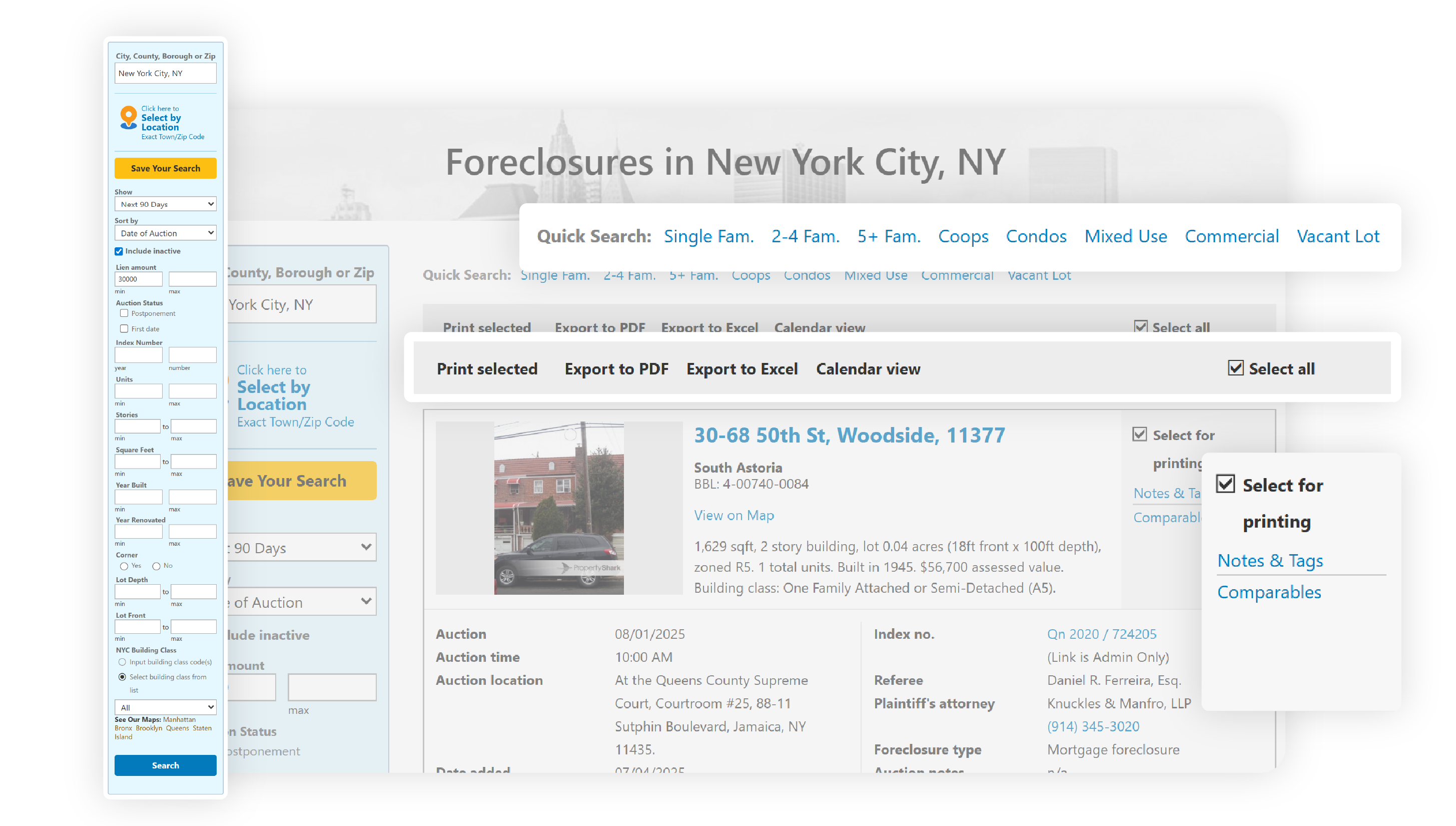
Instead, see how to find foreclosures by signing up for a subscription (or giving our three-day trial a go) to learn how to find distressed properties the quick and easy way. Then, you can thoroughly research the property’s characteristics; tax and sale history; documents; and more — all while also running finetuned comparables based on recent sales of similar properties.
That said, the most straightforward way is to browse available listings. Whether you’re interested in a specific area, property type, or the latest listings, you can finetune your search criteria until the results match your expertise and investment strategy — or you find your dream home.
Filter by Location, Map, Building Type & Property Characteristics or Auction Details
First, sign into your account and ensure that you have an active Elite or Platinum membership (or have activated your three-day foreclosure trial). This is essential because other users will have significantly restricted access to foreclosure data, as well as filtering and organizing tools and property information.
Filter by Location
Click the “Foreclosure” menu in the top menu and select “New York City Foreclosures” (or your appropriate location) to bring up the general foreclosure page for NYC. Next, to narrow your search by location, use the options available in the left-hand menu and filter by city, county, borough or zip code. Then, use the “Select by Location” option to filter by neighborhood, zip code, school district, community district, town or borough.
Search by Map & Added Layers
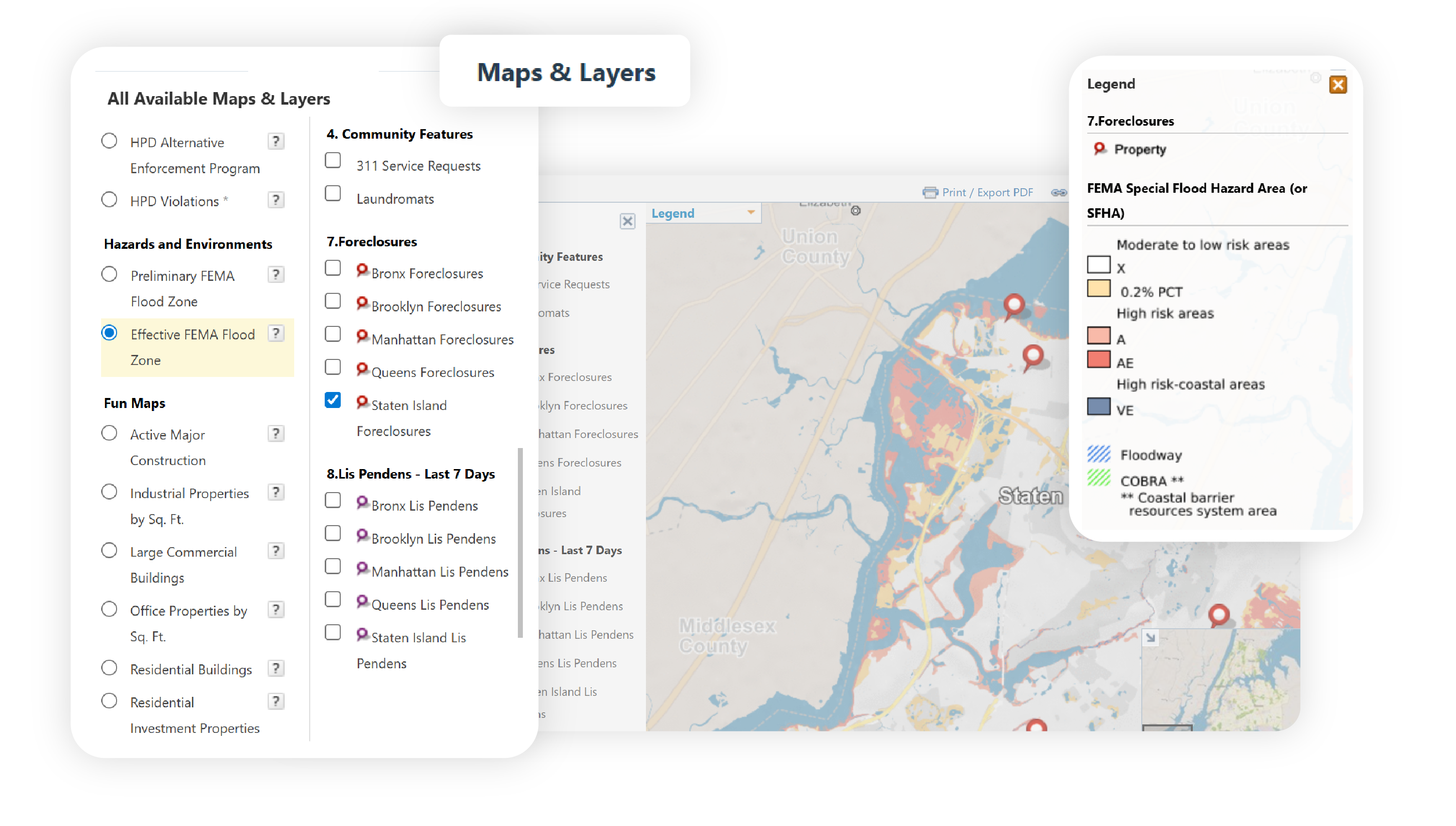
You can go even more granular in your research to discover how to find houses in foreclosure by other property types; by zoning and development; by violations and complaints; by hazards, such as flood zones; by transportation; by tax values; or by sales in the last five years.
Next, scroll to the bottom of the left-hand search menu and select your target borough. This will take you to PropertyShark’s Maps tool, which will open with the most common map layers displayed. Then, for additional search criteria, click the “Get More Maps” button, which will open a host of additional layers. You can even target areas with high concentrations of lis pendens or navigate the interactive map to find areas with no other distressed properties in the vicinity.
Filter by Building Type & Property Characteristics
If you’re only interested in one or a handful of property types, simply select them from the quick search categories at the top of page. Or, for more targeted property type and class searches, scroll to the bottom of the left-hand filter menu, click on the “Select building class from list” menu and choose your target asset classes. Alternatively, you can also manually input the building class code(s).
Property characteristics can also provide a means to further filter your search. For this one, type in your minimum and/or maximum size limits for number of units, stories, square footage, lot depth or lot frontage. You can even set specific criteria for the building’s age and when it was last renovated.
Filter by Auction Details
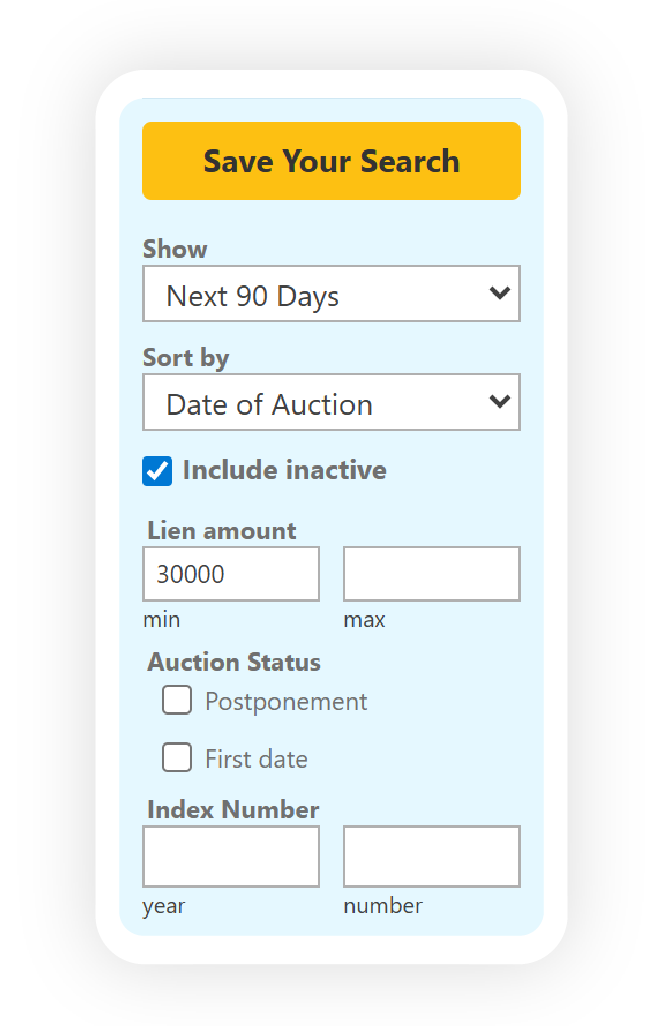
If you’re looking to further refine your search results or are interested to know how to find foreclosures from a specific time period, you can also choose to sort properties by “Date of Auction” by selecting only those that went into foreclosure in the last seven days, 90 days or during any month in the last 11 years.
You can also choose to view only first-time foreclosures or postponed auctions and set lower and upper lien amount values.
Organize Your Search Results
Of course, knowing how to quickly look up foreclosures is just one part of the equation. You also need efficient ways to organize your target properties. So, as you review your search results, make sure to add them to your “Watch List” so you can circle back later and review your selections. This will also automatically sign you up to receive email notifications of important developments with your target properties, including sales, relistings and new auction dates.
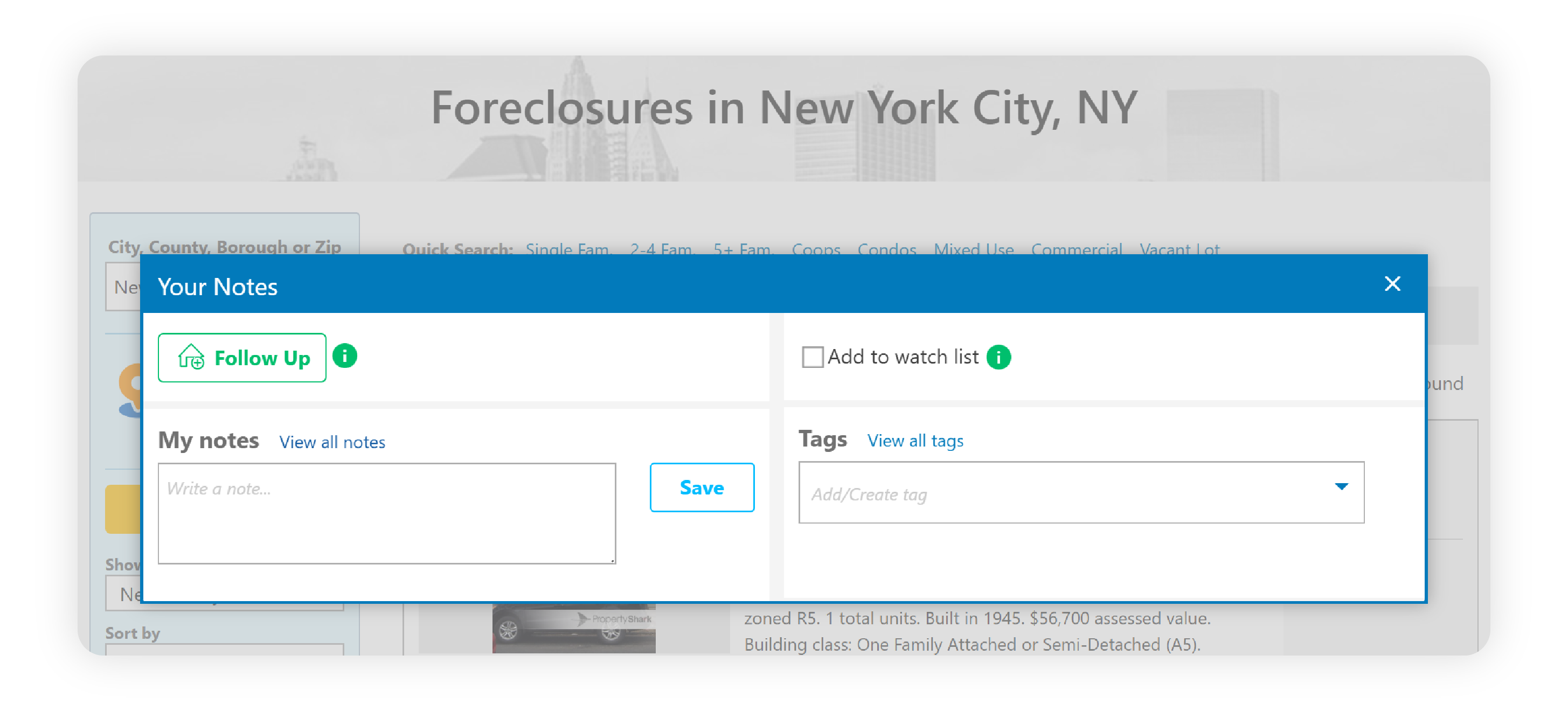
Additionally, you can schedule follow-ups, add private tags and write quick notes to yourself in the pop-up window that appears after clicking “Notes & Tags” on the right side of your screen.
After you’ve personalized all of your search criteria, save your property list by clicking “Export to PDF,” which will include all foreclosure listing details, including property photos. Alternatively, if you’re looking to run further analyses on your property list, you can export it to an Excel document.
Or, if you need physical materials for in-person presentations or client meetings, you can select your entire list or just specific properties and click “Print selected.” (Print lists will be very similar to PDF exports, up to and including property photos.)
You can even run accurate comparables without resetting your foreclosure prospecting. Simply click on “Comparables” on the right side of a foreclosure listing and it will open in a new tab, allowing you to view and refine estimates before returning to your original search.
See Auction Results Without Attending In Person
If you’re taking the pulse of the foreclosure market and don’t want to attend any live auctions just yet, you can use this tool to research auction results from the comfort of your home or on the go. Simply open the “Foreclosures” dropdown menu at the top of the page and select “New York City Auction Results.” There, you’ll find the same search filters and options to organize results as you do with foreclosures searches.
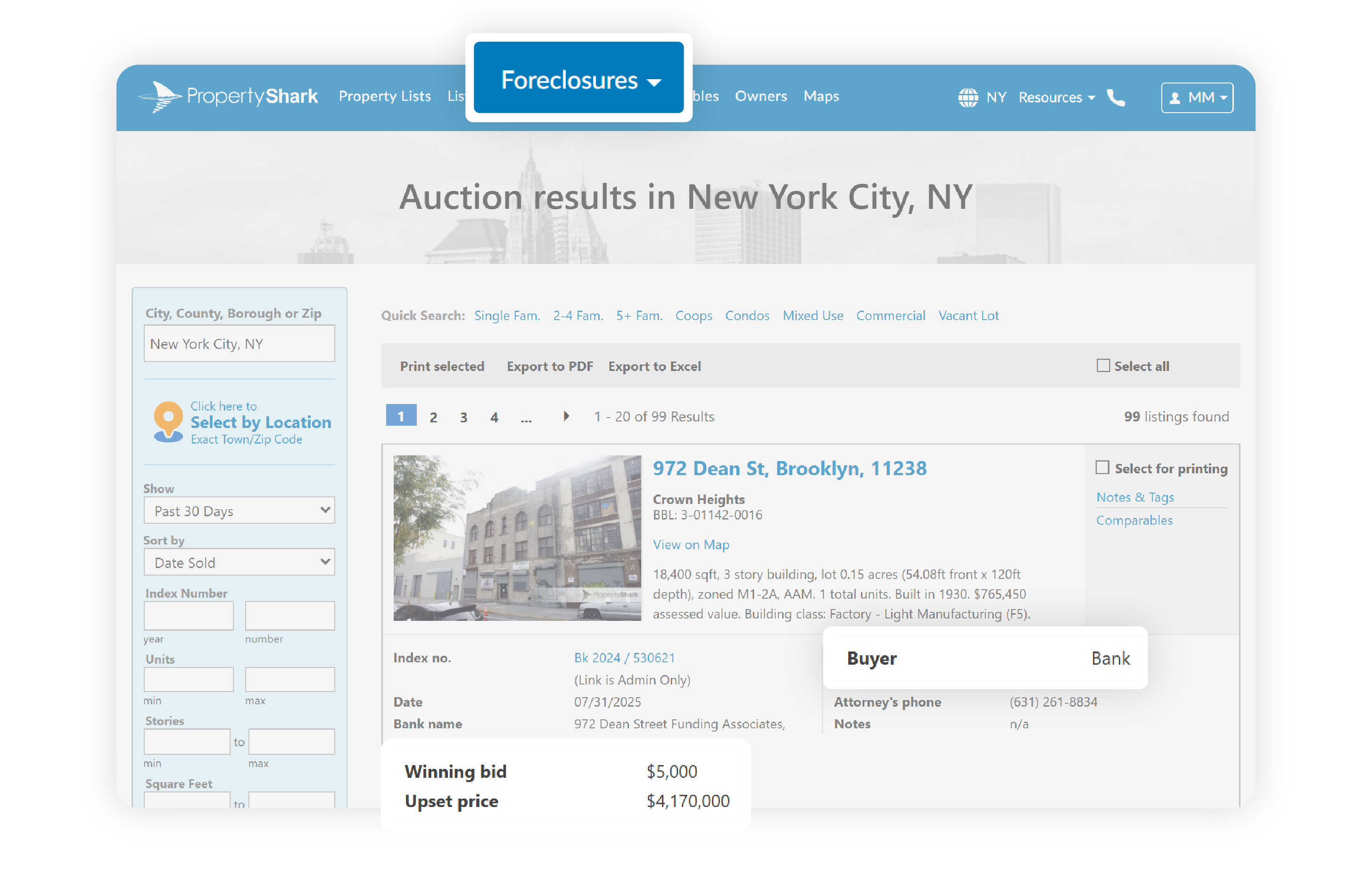
Now, you can view and gather data about auctions that have already taken place. For new and seasoned investors alike (as well as homebuyers), this is a great way to learn about the foreclosure market, including what kind of properties sell and at what price point; how much higher than the starting bid other investors go; and more.
Observing these patterns will show you what you can expect to see when attending an auction and can even help you identify trends before others. This is also the quickest way to learn about new bank-owned properties on the market even before the bank starts advertising them.
Find Bank-Owned (REO) Foreclosures
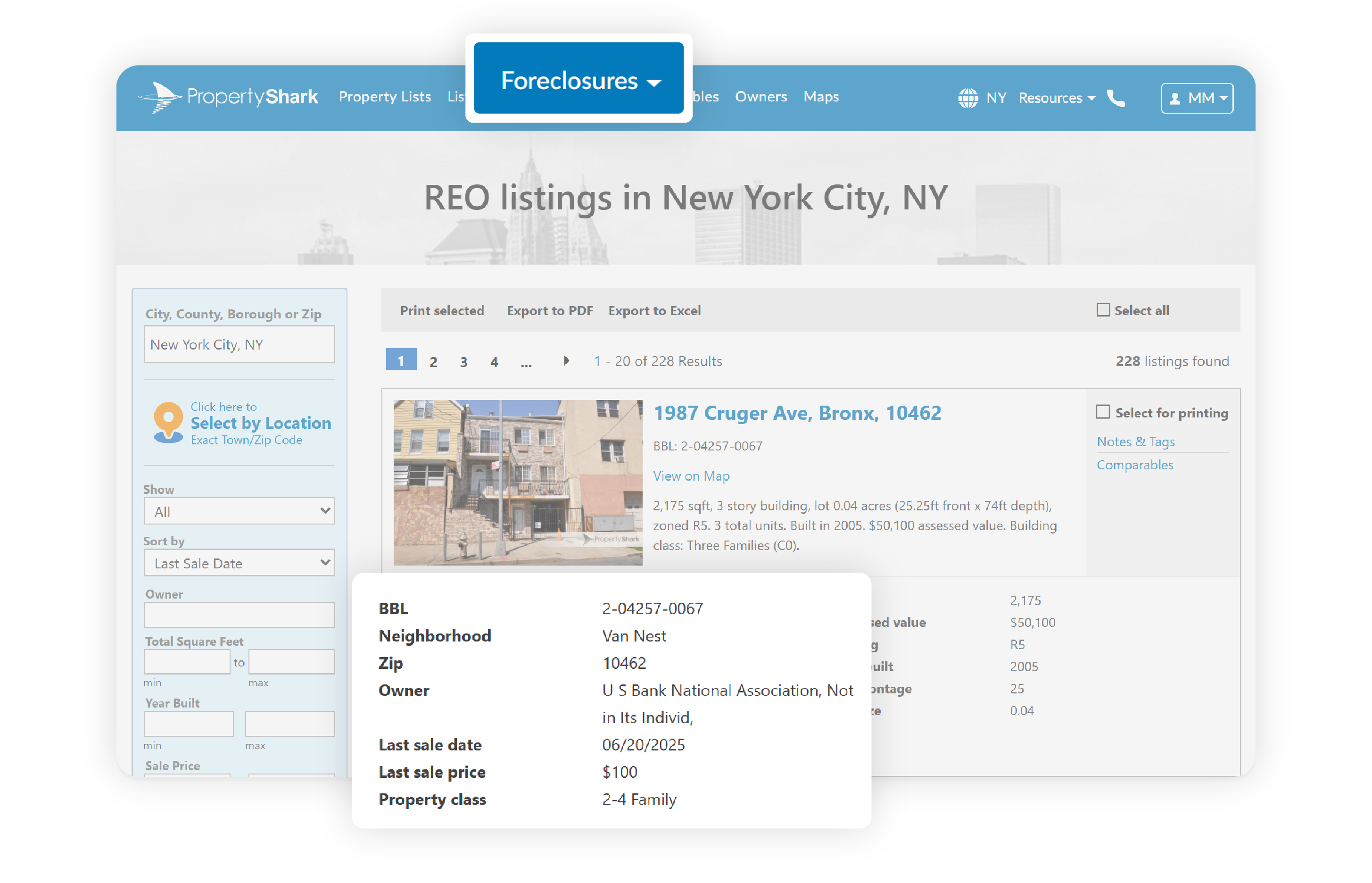
If the winning bid in an auction is lower than the upset price, the property will stay with the bank or lender and will either return to auction at a later date or be made available for purchase directly by the bank/lender or through a real estate agent contracted by the lender. Simply select “New York City Bank-Owned (REO)”from the “Foreclosures” drop-down menu to view repossessed properties.
Conclusions
Whether you’re looking to purchase your dream home or expand your investment portfolio, understanding how to find foreclosures is a critical skill with a significant competitive edge. By efficiently locating and assessing foreclosed properties, you can save time, effort and resources while maximizing your investment potential.
Whether you choose to traditional methods like researching county records and court filings, hire a professional, work with financial institutions or choose an experienced data provider like PropertyShark, choosing the right properties and staying organized with your research and prospecting is key. If you’re looking to discover distressed property opportunities even earlier in the process, see the easiest ways to find pre-foreclosures.
Disclaimer
Information provided on this page is purely informational. It is not and should not be regarded as investment advice. Individuals looking to invest in foreclosed or distressed properties should always complete their own foreclosure due diligence.
*Service available to Elite and Platinum clients in Arizona, California, Florida, Illinois, New Jersey, New York and Pennsylvania.
Latest Posts
Want to stay on top of the real estate market?
Access comprehensive property data and ownership information with intuitive research tools.


Eliza Theiss is a senior writer reporting real estate trends in the US. Her work has been cited by CBS News, Curbed, The Los Angeles Times, and Forbes among others. With an academic background in journalism, Eliza has been covering real estate since 2012. Before joining PropertyShark, Eliza was an associate editor at Multi-Housing News and Commercial Property Executive. She has also contributed extensively to CommercialEdge. Reach her at [email protected]
Recent Reports

NYC Homeownership by the Numbers: How Household Type, Gender & Age Shape Who Owns in Every Neighborhood
In a city where homeownership is dominated by married-couple families, Manhattan stands as the only borough led by nonfamily owners. At the same time, residents younger than 35 make up less than one tenth of the ownership pool and female-led family households outnumber male-led families across 91% of NYC neighborhoods.

Prices Rise in 32 of NYC’s Leading Neighborhoods as City and Manhattan Hit Record Highs
Q2 2026 saw NYC and Manhattan reach historic highs, with Brooklyn and Queens marking close to new records as well. Meanwhile, Hudson Yards remained at the top, Central Midtown posted its highest price ever and Carroll Gardens marked its third consecutive quarter over $2 million

2026 Q2 Foreclosure Report: Bronx Caseload Hits 7-Year High, Brooklyn & Manhattan Slow to 4-Year Low
Manhattan yet again slowed to become the city’s least active foreclosure market, Brooklyn’s caseload dropped so low it barely edged out Staten Island, while the Bronx heated up enough to surpass all boroughs except Queens.