

New York Real Estate | 7 minute read
How to Find Liens on a Property: A Step-by-Step Lien Search Guide
By Laura Pop-Badiu | Oct 22, 2014
Want to know how to find liens on a property? Quickly discover any property lien, including mechanic's liens, tax liens, mortgage liens and more.
Editor’s Note: This article was updated on September 2, 2026.
If you need to learn how to find liens on a property, treat it as a due-diligence step instead of a simple convenience check. Liens can affect whether a title transfers cleanly, whether a lender will fund, as well as how you should price or negotiate a deal. For buyers, brokers and investors, that means lien research should be incorporated early in the acquisition workflow.
In practice, learning how to check for liens on property usually revolves around three distinct methods: You can search the county recorder or clerk records yourself, order a title search through a title company or use a research platform like PropertyShark to review lien filings and other recorded documents like the ownership history, mortgage data and tax history.
Why Lien Searches Matter in Real Estate Deals
A lien is a legal claim attached to real estate that can affect ownership, closing, financing or resale. Unpaid property taxes, judgment liens and liens for unpaid repairs or renovations are typically among the title defects buyers need to watch for. If those issues are unresolved, they can change the risk profile of a property, making it harder for buyers and investors to close a deal.
Liens function as tools that help protect the interests of creditors, contractors, co-op or homeowners’ associations, as well as utility companies, tax authorities, environmental organizations and government associations. There can even be spousal and child support liens attached to a property.
That also matters for valuation and negotiation. A property with recorded debt, tax issues or other encumbrances can still be a viable acquisition, but the pricing and structure should reflect that. PropertyShark property reports are specifically built for this kind of early-stage due diligence because they combine verified public record data, deed filings, ownership history, tax information, plus mortgage and lien data so users can make faster, better-informed decisions.
Lien checks also matter because title and closing professionals rely on them. Title services typically include title searches and other services associated with issuing title insurance and title professionals review public records to identify issues like unpaid liens before a transaction is completed. In other words, if you are buying or financing real estate, lien research is not optional, rather it is part of the normal risk-screening process.
So, if you want to know how to find out if a house has a lien or how to find delinquent property tax lists, here are some of the most efficient ways to uncover all liens attached to a property.
How to Check for Liens on Property
Method 1 (Free): Search through county recorder or clerk records
The free route to uncovering liens is through county recorder or clerk records, usually paired with county assessor records. The assessor is often the easiest place to start because it can help you confirm the owner’s name, mailing address and APN or parcel number.
Once you have the parcel number or the owner’s name, you can move to recorder or clerk land records. Official county land record systems maintain recorded deeds, mortgages, liens, judgments, plats and related instruments. However, there is an important limitation: Not every county structures searches the same way, which means that the manual lien research process can be slow and tiresome, especially when done at scale.
If you are trying to answer how to look up liens on a property, expect to bounce between assessor, recorder, court and tax records, depending on jurisdiction. In many cases, researchers may need to consult an attorney or title company because of the complexity of land records.
Method 2 (Paid): Order a title search through a title company
If you need a transaction-ready answer rather than a preliminary screen, you can order a title search through a title company. Title services generally include title searches, title insurance and related closing services. Title professionals review public records to identify issues such as unpaid liens, recording errors or title encumbrances. This is the route to take when you are under contract, lining up financing or need insurable certainty before closing a deal.
Method 3 (Paid): Use PropertyShark for preliminary lien research
If you want a faster research workflow before you order a title search, PropertyShark can centralize the main documents and signals.
A practical step-by-step process looks like this:
- Search the property by address, owner name or parcel ID in the main search bar.
- Check the full report to access all the available information about your property of interest. Reports are available across major U.S. markets, though data depth varies by location and subscription. You can also search by owner name with the deep owner search tool, which will also prompt you with the option to open a full property report.
- Review the ownership information in the Contacts tab and in the sales history section of the Documents tab to confirm the current owner, deed history, transfer dates and prior transactions.
- Check the lien information section under the Documents tab, then look for mortgage details in the Financials tabs for the lender’s name, loan amounts, maturity dates and foreclosure or pre-foreclosure filings where available.
- Cross-check the Tax tab for tax amounts, assessment dates and assessed values.
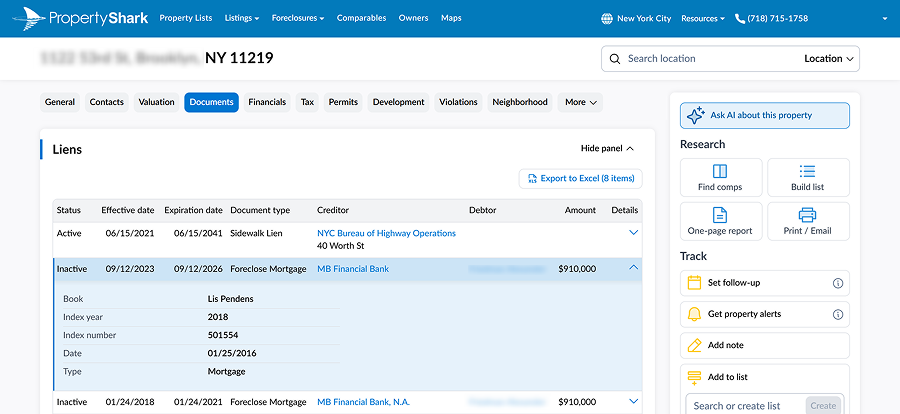
PropertyShark can help uncover encumbrances early, but it is not a substitute for working with a title company and securing title insurance. For professionals, the right sequence is: Use PropertyShark to triage deals quickly, then escalate to an official title search before closing.
What Type of Liens Can You Find on PropertyShark?
PropertyShark users can research liens, judgments and legal encumbrances and the property reports may show liens, deed records, mortgage documents, tax details and related filings, all subject to regional availability. If you’re performing a title search for a New York property, PropertyShark can help you find the following types of encumbrances:
- Mortgage liens: Also known as lis pendens or pre-foreclosures, they are issued against properties that are behind on their mortgage payments. You can explore the PropertyShark’s NYC pre-foreclosure coverage.
- Judgment liens: Issued when the owner loses a lawsuit and receives a judgment for monetary compensation.
- Tax liens: Issued for unpaid property taxes. Can include federal, state, and municipal tax liens.
- Mechanic’s liens: Also known as contractor liens, they are filed by contractors and suppliers when they haven’t been fully compensated.
- Building code violation liens: Issued when a property owner fails to pay penalties stemming from not complying with local building codes
- Common charge/ HOA liens: Filed by the association or management of a community/development for unpaid common expenses.
- Spousal/child support liens, environmental liens and other, less common types of liens.
Why Checking for Liens Is a Crucial Part of Your Buying Process
For brokers and investors, lien research is most important before you make or accept assumptions about value. A property with a clean exterior and a workable price may still carry debt or recorded claims that affect closing strategy, seller flexibility or net proceeds. That is especially relevant in off-market acquisitions, distressed purchases, small multifamily sales and land deals, where the debt stack can materially affect timing and pricing.
These are some of the main benefits of checking for liens before pursuing and closing a deal:
Save time & unnecessary hassle
If there’s a lien on a property you’re interested in, creditors will likely step in if it remains unsatisfied before you finish closing. Notably, the revenue generated by the sale of property with a lien attached is typically used to pay off the lien, but things can get complicated if the owed amount exceeds the value of the property.
Therefore, performing a thorough lien search before investing time and resources into an asset might just save you and your clients’ time and unnecessary hassle.
Protect your investment from financial liability
Should you close on a property with outstanding debt in the form of undisclosed liens, you can easily be held liable for them as the new owner. And be forced to settle the debt and associated costs.
Clear up title issues
If your efforts in how to find liens on a property have uncovered significant liens, these can potentially create title issues and lead to inaccuracies and uncertainties regarding ownership. This can then affect not only the marketability of your chosen property, but may also lead to the partial or even full loss of ownership rights.
Use it as leverage when negotiating
Discovering liens prior to making an offer gives you an advantage heading into negotiations. That’s because it’s easier to negotiate with an owner who is eager to sell the property to pay off a debt.
Identify potentially irresponsible owners and manager
Liens on a property can be a sign that maintenance and repairs were not prioritized throughout the years. Generally, if an owner is struggling financially or is financially irresponsible, maintenance of the property is often neglected.
The same goes for apartment buildings: Liens can also indicate that the building’s owner or manager might not have had the funds to properly maintain it or has simply decided to ignore issues. Alternatively, it could also be the case of an absentee owner.
Pinpoint hidden problems that threaten property value
Multiple mortgage liens can lead to property values dropping in the surrounding area. Although one or two mortgage liens in an area likely won’t do any consistent damage, neighborhoods where a large number of homes have liens can quickly become a distressed area, lowering property values.
Maintain the Ability to Borrow Against or Sell the Property
If you need to sell the property or simply want to extract yourself from a complicated situation, outstanding liens will affect the sale price, which may result in financial losses. A a lien on a property can also make it significantly more difficult to refinance.
Conclusion
If you are wondering how to find liens on property, the practical answer is to start with public records, use real estate data platforms to speed up the first phase and hire a title company when the deal progresses to a more advanced stage. County recorder and clerk systems, the official source for recorded land documents and are generally free to access, but for lien searches this option can be fragmented and inconsistent between jurisdictions
For real estate professionals, PropertyShark can make preliminary lien research much faster by bringing ownership, deed history, mortgage information, lien data, tax records and document histories into one workflow. It’s a practical approach to spot issues early, evaluate risk more effectively and decide when a property needs a full title search.
FAQs
Can liens affect closing?
Yes. Liens can affect whether title transfers cleanly and may need to be paid, released or otherwise resolved before closing or financing. Title services exist in part to identify those issues before the deal closes.
Are all liens recorded publicly?
Many liens tied to real estate are publicly recorded, but searchability varies by lien type and jurisdiction. County land records may be indexed by owner name, parcel number, document type or other fields — not always by address — and some related filings may sit outside a simple address search workflow. That is one reason title searches remain necessary.
How far back can you find liens?
It depends on the county and the tool you use. Some county clerk’s offices maintain permanent land records, but their online indexes don’t always cover full recordkeeping timeline. PropertyShark data depth also varies by market based on local public record availability.
Disclaimer
Information provided on this page is purely informational. It is not and should not be regarded as investment advice.
Note: A different version of this article was featured in BrickUnderground in 2013.
Latest Posts
Want to stay on top of the real estate market?
Access comprehensive property data and ownership information with intuitive research tools.


Laura Pop-Badiu is a Senior Creative Writer at PropertyShark, with a degree in Journalism and a background in both hospitality and real estate. Laura is a certified bookworm with a genuine passion for the written word and a keen interest in the real estate market, having previously written for Yardi's RentCafe, CoworkingCafe and CoworkingMag. Her work has been featured in major publications like The New York Times, Forbes, NBC News, The Business Journals, Chicago Tribune, MSN and Yahoo! Finance, among others.
Recent Reports

NYC Homeownership by the Numbers: How Household Type, Gender & Age Shape Who Owns in Every Neighborhood
In a city where homeownership is dominated by married-couple families, Manhattan stands as the only borough led by nonfamily owners. At the same time, residents younger than 35 make up less than one tenth of the ownership pool and female-led family households outnumber male-led families across 91% of NYC neighborhoods.

Prices Rise in 32 of NYC’s Leading Neighborhoods as City and Manhattan Hit Record Highs
Q2 2026 saw NYC and Manhattan reach historic highs, with Brooklyn and Queens marking close to new records as well. Meanwhile, Hudson Yards remained at the top, Central Midtown posted its highest price ever and Carroll Gardens marked its third consecutive quarter over $2 million

2026 Q2 Foreclosure Report: Bronx Caseload Hits 7-Year High, Brooklyn & Manhattan Slow to 4-Year Low
Manhattan yet again slowed to become the city’s least active foreclosure market, Brooklyn’s caseload dropped so low it barely edged out Staten Island, while the Bronx heated up enough to surpass all boroughs except Queens.