

New York Real Estate | 5 minute read
How to Quickly Find Property Owners’ Phone Numbers
By Laura Pop-Badiu | Feb 19, 2026
Finding homeowners’ phone numbers isn’t always easy or straightforward. Privacy limitations and outdated public records often make manual searches slow and inconsistent. In this guide, we break down practical, verified methods used by real estate professionals to find property owners’ phone numbers efficiently.
Knowing how to find property owners’ phone numbers is a critical skill for real estate professionals who rely on direct outreach to uncover new opportunities. Whether you’re looking for off-market deals, building a pipeline of motivated sellers or simply conducting ownership due dilligence, access to accurate owner contact information can significantly ease the process.
However, learning how to find homeowners’ phone numbers isn’t always easy or straightforward. Privacy limitations and outdated public records often make manual searches slow and inconsistent. This is why, in this guide, we break down practical, verified methods used by real estate professionals to find owners’ phone numbers efficiently.
Why Real Estate Professionals Need Direct Access to Property Owners
Direct communication with property owners can be the cornerstone of many high-value real estate strategies. Among them, these are the most common and effective:
- Off-market deals and acquisitions: Many investment opportunities never hit the MLS, which is why investors and developers often rely on direct owner outreach to identify sellers before a property is publicly listed.
- Listings and seller representation: Agents who can reach owners directly are better positioned to secure exclusive listings and establish relationships ahead of competitors.
- Due diligence and ownership verification: Accurate owner contact details help confirm decision-makers, clarify property status and reduce friction during negotiations.
Challenges with Finding Accurate Contact Information
While ownership data is generally public, phone numbers are not always easily accessible or up to date. The most common challenges when learning how to find homeowners’ phone numbers include:
- Real ownership hidden through LLCs, trusts or holding companies
- Outdated or missing contact details in county records
- Time-consuming manual searches across multiple databases
- Inconsistent data quality from non-specialized sources.
These obstacles are the main reasons why it’s essential to use research tools and workflows specific to real estate.
Why Property Owner Phone Numbers Matter in Real Estate
Learning how to find phone numbers of property owners is essential to many real estate strategies and opportunities that ultimately impact your bottom line. Here are some examples:
Off-market investing opportunities: Direct outreach allows investors to reach property owners before competition.
Lead generation for agents and wholesalers: Calling owners directly supports consistent pipeline building and faster lead qualification.
Direct-to-owner outreach advantages: Compared to email campaigns, phone calls enable immediate feedback, handling objections and building rapport.
Speed vs. traditional listing platforms: Traditional platforms show properties already exposed to the market, whereas direct owner contact prioritizes speed, access and exclusivity.
How to Find Property Owners’ Phone Numbers in Real Estate
Search County Property Records
Where to Look
For many real estate professionals, county property records are the natural first stop when trying to find property owners’ phone numbers. These records are publicly available and provide a foundational layer of ownership information that can help confirm who owns a property and how they hold it.
When This Method Works
County assessor databases, recorder or clerk offices and property tax records typically list the legal owner’s name and mailing address. When a property is owned by an individual — especially in the case of single family or small residential properties — these records can sometimes point you in the right direction and help narrow the search for contact information.
When This Method Doesn’t Work
However, county records have clear limitations. Properties owned through LLCs, corporations or trusts rarely include direct phone numbers. Plus, many jurisdictions do not publish phone contact details at all, due to privacy restrictions. So, while county records are useful for identifying ownership, phone numbers are not guaranteed, making additional research or specialized tools necessary.
Why Use Property Research Platforms Built for Real Estate
Real estate research platforms aggregate public records, licensing data and verified contact information into a single workflow. This is why real estate professionals use data platforms when looking for property owners’ phone numbers.
Depending on the platform, users may access:
- Ownership histories
- Mailing addresses
- Registered or verified phone numbers
- Properties associated with the same owner
Instead of checking multiple county databases, professionals can retrieve ownership and contact data in minutes, rather than hours. Learning how to build property owners lists can also help ease and speed up the outreach process.
How to Find a Property Owner’s Phone Number Using PropertyShark
PropertyShark is designed specifically for real estate professionals who need reliable property and ownership information for thorough due diligence. To find property owner’s phone numbers in PropertyShark, these are the steps that you need to follow after creating a free account:
1. Search by property address: Enter the full address into PropertyShark’s search bar to access the property report.
2. Review the Contacts tab: The ownership section displays the registered owner, ownership type (individual or entity) and related property details.

3. Access available contact details:
- Registered phone numbers for registered owners, nationwide
- Verified phone numbers for NYC property owners, where available
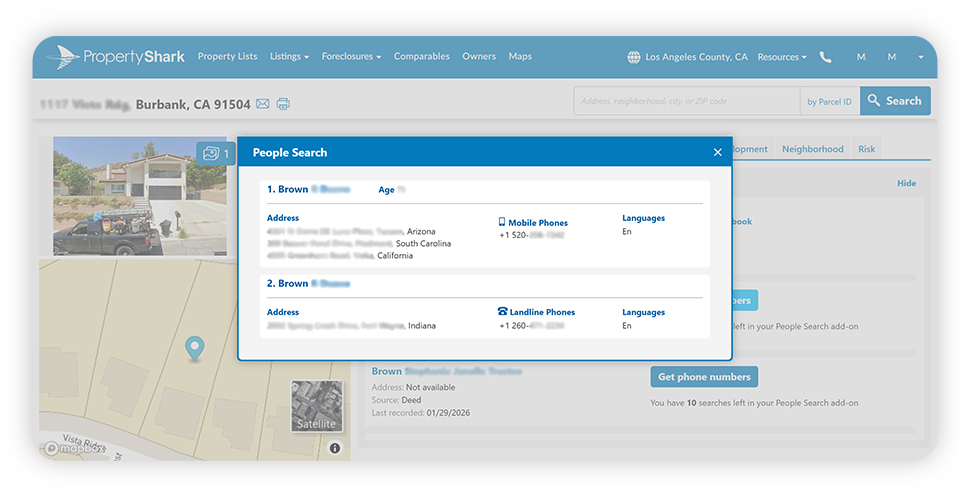
Alternative: Run a deep owner search
If a phone number is not immediately visible:
- Search by owner name
- View all properties associated with that owner
- Access available contact details tied to the ownership profile
This method is especially effective for investors researching portfolio owners or repeat sellers.
PropertyShark is effective for: Investors sourcing off-market opportunities; agents pursuing exclusive listings; wholesalers building direct-to-sellet pipelines; developers identifying decision-makers behind complex ownership structures.
Business Entity & LLC Ownership Lookup
Many properties are owned through LLCs or other business entities to limit liability, which can make identifying decision-makers more challenging. The right research tools, however, cand make it easy to see past the LLC and find the real owners.
PropertyShark can help uncover LLC ownership for NYC properties. With a paid subscription, you can simply run a property search by address as you would for any owner search. Once you find the property you’re interested in, go to the Contacts tab and check out the Real Owners section.
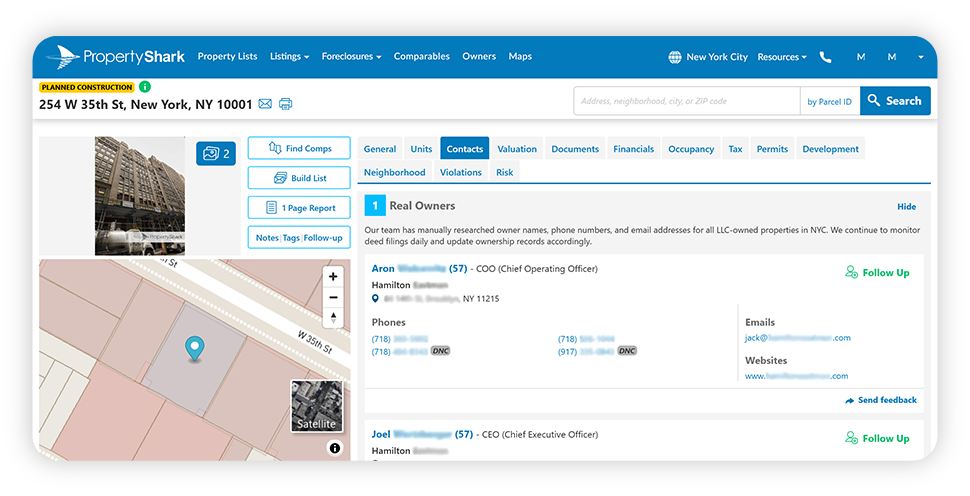
PropertyShark connects property records with business and ownership data, helping users identify managing members, related properties and ownership patterns across locations. When phone numbers aren’t available, mailing addresses and portfolio-level insights can provide a starting point and help guide outreach.
Access ownership details and available contact information faster for direct outreach and due diligence.
Create a free account now
Best Property Types for Direct Owner Outreach
Certain property categories consistently perform better for direct contact strategies. Among them, these are the ones generally targeted by real estate agents and professionals:
- Vacant properties: Owners may be motivated to reduce carrying costs.
- Absentee owners: Out-of-area owners are often more inclined to sell.
- Distressed or pre-foreclosure assets: Early contact can uncover solutions before public notices escalate.
- Multifamily and mixed-use properties: These assets are frequently owned by professional investors open to portfolio discussions.
Outreach Tips for Real Estate Professionals
Call scripts that convert: Be concise and transparent and reference the property directly. First, ask open-ended questions instead of immediately pitching.
Best times to contact owners: Late mornings and early evenings typically have higher answer rates. Mid-weekdays can also increase the chances of success.
Follow-up strategies: Multiple attempts over time outperform one-off calls. Track outreach consistently and have a long-term strategy.
When to switch from calls to mail or email: If calls go unanswered, combine outreach methods to increase response rates without over-contacting.
Conclusion
Learning how to find property owners’ phone numbers is a foundational skill for real estate professionals focused on efficiency, access and off-market opportunities. While county records provide a starting point, they are often incomplete or inefficient for deal-driven workflows.
Using a real estate–specific research platform like PropertyShark allows professionals to identify ownership quickly and access available, verified contact details. Responsible, professional outreach — supported by accurate data — remains one of the most effective ways to uncover real estate opportunities before they reach the broader market.
FAQs
Is it legal to contact property owners for real estate deals?
Yes. Contacting property owners using publicly available information is legal — though uncommon — provided outreach complies with applicable telemarketing, privacy and do-not-call regulations.
What is the fastest way to find a property owner’s phone number?
Using a real estate research platform that aggregates ownership and contact data is typically faster than manual searches through multiple public records.
Are property owner phone numbers always available?
No. Availability depends on ownership structure, jurisdiction and public disclosures. Some owners, especially entities, may not have phone numbers publicly listed.
Access comprehensive property data and ownership information with intuitive research tools.


Laura Pop-Badiu is a Senior Creative Writer at PropertyShark, with a degree in Journalism and a background in both hospitality and real estate. Laura is a certified bookworm with a genuine passion for the written word and a keen interest in the real estate market, having previously written for Yardi's RentCafe, CoworkingCafe and CoworkingMag. Her work has been featured in major publications like The New York Times, Forbes, NBC News, The Business Journals, Chicago Tribune, MSN and Yahoo! Finance, among others.
Recent Reports

NYC Homeownership by the Numbers: How Household Type, Gender & Age Shape Who Owns in Every Neighborhood
In a city where homeownership is dominated by married-couple families, Manhattan stands as the only borough led by nonfamily owners. At the same time, residents younger than 35 make up less than one tenth of the ownership pool and female-led family households outnumber male-led families across 91% of NYC neighborhoods.

Prices Rise in 32 of NYC’s Leading Neighborhoods as City and Manhattan Hit Record Highs
Q2 2026 saw NYC and Manhattan reach historic highs, with Brooklyn and Queens marking close to new records as well. Meanwhile, Hudson Yards remained at the top, Central Midtown posted its highest price ever and Carroll Gardens marked its third consecutive quarter over $2 million

2026 Q2 Foreclosure Report: Bronx Caseload Hits 7-Year High, Brooklyn & Manhattan Slow to 4-Year Low
Manhattan yet again slowed to become the city’s least active foreclosure market, Brooklyn’s caseload dropped so low it barely edged out Staten Island, while the Bronx heated up enough to surpass all boroughs except Queens.