

New York Commercial Real Estate | 13 minute read
How to Find Property Owners — The Complete Guide
By Laura Pop-Badiu | Jul 15, 2026
For real estate professionals looking for the best ways to find property owners — whether through free methods based on public sources or paid tools with verified, in-depth data — this comprehensive guide breaks down every step of the due diligence process.
If you need to look up property owners, the fastest and most reliable starting points are the county assessor or property appraiser records, county recorder or property deed records, tax records and GIS parcel maps, along with property databases that pull all these documents together. It’s important to consider, however, that the best route depends on what you are researching, be it a house, a vacant lot, an LLC-owned building, a commercial property or an owner’s full portfolio.
For a faster and often more reliable workflow designed to find property owners by address, a real estate database like PropertyShark allows you to search by address, parcel ID or owner name, then review details like ownership history, deeds, taxes, zoning, mortgage and map data, all in one place. If you opt for this path, keep in mind that data depth can vary by market.
The Easiest Ways to Look Up Property Owners
Check county assessor and property appraiser records
County assessor or property appraiser records often include the parcel number, address, owner name, mailing address, assessed value and basic parcel characteristics, which makes them the best place to start a property owner search. County assessors can also maintain parcel ownership information and updates records when the property is sold, transferred, combined or split.
Verify recorder, clerk and deed records
The recorder or clerk is where you confirm ownership transfers, as recorded deeds and related land documents represent the official history of who transferred what to whom. The recorder’s role is to record and maintain real property transactions and preserve those records for public access.
Review tax and mailing address records
Tax records are useful when you need a mailing address for the owner of record, especially for absentee-owner research. Assessor rolls typically maintain mailing information for tax purposes and some offices even provide a formal process to update mailing addresses tied to parcels.
Look up GIS and parcel map systems
GIS parcel viewers help you match owner records to the correct lot, especially when an address is incomplete, duplicated or missing altogether. Parcel viewers may show property lines and land ownership information sourced from county assessor databases, but county map portals also regularly warn that the online map is not the official legal record itself.
Confirm information through property owner search tools
Property owner search tools speed up research by bringing ownership, deed, tax, zoning, mortgage and map data together, helping you research in one place instead of consulting disparate sources and matching information across them.
For instance, PropertyShark users can search by address or parcel ID and review current owners, mailing addresses, deed hand sales histories, tax data, zoning details, as well as mortgage and lien information directly in the property report, significantly speeding up due diligence processes.
Read our article on how to find land boundaries through both free and paid methods.
How to Look Up Property Owners by Address
Both free and paid tools have their own advantages and challenges. While manual workflows are reliable, they’re also fragmented and time-consuming. They often require switching between assessor, recorder, GIS and secretary of state databases before you can confidently say you have identified the correct owner.
By contrast, a paid tool like PropertyShark makes the process significantly faster and more efficient because all the core record types can be found in one environment. Plus, with PropertyShark, workflows extend naturally from an address to an owner, then to a portfolio or a lead list. However, the full range of data is available only with a paid subscription.
Now, explore step-by-step workflows for finding property owners by address:
Manual search: Using public records
If you want to find property owners by address using public records alone, the workflow is straightforward, though it can also be more tedious and time consuming:
- Access your county assessor or property appraiser of choice and search by street address
- Note the parcel number/APN, owner name and mailing address, if available
- Search the county recorder or clerk for deeds and transfers by address, grantor, grantee or any other indexed fields that county platform supports
- Open the GIS parcel viewer to confirm you are looking at the right lot and adjacent parcels
While this process can lead to the desired results, it is cumbersome since records are usually split across different offices and platforms. Plus, county record databases and interfaces can vary between different government branches and from county to county, meaning you may not be able to use the same or even similar search fields when consulting records across multiple sources.
Streamlined searches with PropertyShark
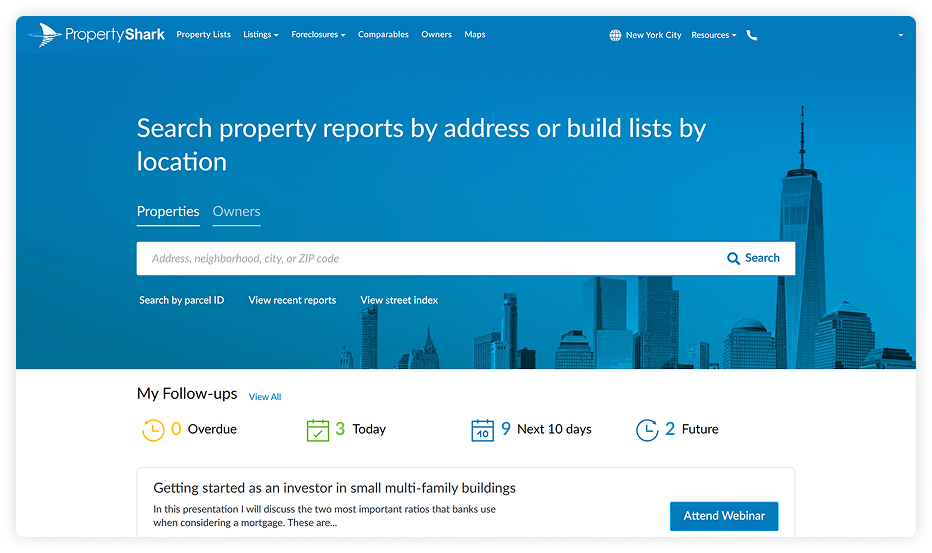
PropertyShark compresses that fractured workflow into one search path, helping you find property owners faster and more efficiently:
- Enter the property address, parcel ID or owner name in the search bar
- Open the property report to see more details
- Review current ownership, mailing addresses, deed and sales histories, taxes, zoning details and mortgage or lien data
- Use the maps feature or ownership tools for additional context, or owner-related research and to identify neighboring parcels
Pros and Cons of Using Public Records vs. Owner Lookup Tools
Free, public records are generally a good place to start when trying to find property owners by address, however, they do pose some limitations. Owner lookup tools generally require a subscription, but they tend to encompass more information and deeper insights. Depending on the use case, consider the pros and cons:
| Pros | Cons | |
| Public records | Official source for deeds and ownership Free for small-scale research Useful for parcel and tax verification | Data is fragmented across separate systems Online maps are not the legal record Time-consuming |
| Owner lookup tools | Combine records, maps and ownership data Faster for large-scale research Better for filtering, exports and outreach | Coverage and data depth varies by market Typically require a paid plan Still depend partly on local public data |
The practical takeaway is to use public records when you need a free, official starting point and to use a consolidated research tool when you need to move faster, compare more parcels, identify owner portfolios or build outreach lists.
Best Records to Use When Researching a Property Owner
Ownership records
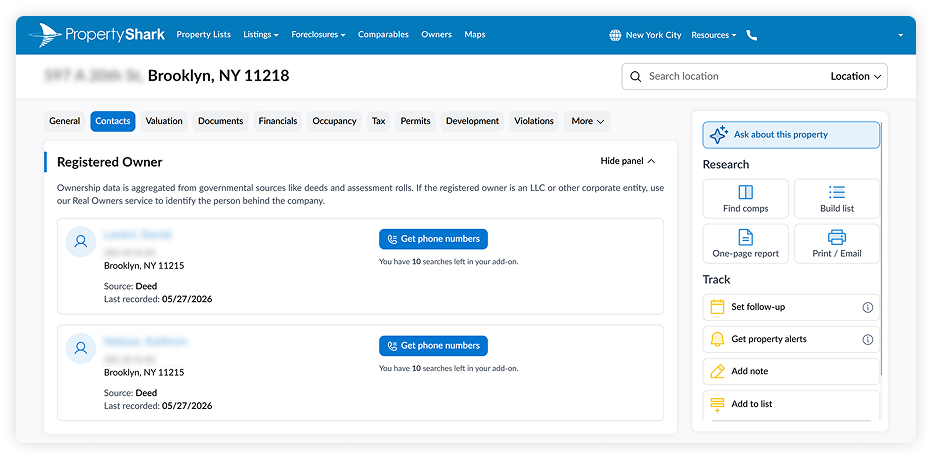
Start with the current owner and the mailing address attached to the parcel. On PropertyShark, those appear under the contacts tab in the full property report (either as a registered owner or a real owner), while on public systems they are commonly found through the assessor or appraiser.
Deeds and title transfers
Deeds and transfer documents tell you who granted and received the title and when. Deeds, liens, mortgages and tax histories can all be reviewed through PropertyShark. However, when trying to find property owners, a self-service title search is only a preliminary step and not a substitute for title insurance or a title company when legal certainty matters.
Tax records and mailing addresses
Tax records are practical for outreach because they often show where tax bills are sent, which may differ from the property address. For example, public assessor rolls frequently include a mailing field. Similarly, PropertyShark’s contacts section includes the current owner and one or multiple mailing addresses where available.
Parcel maps and boundaries
Parcel maps help you confirm that you have the right property before you spend time on deeper ownership research. Parcel viewers may show property lines and ownership information from county assessor databases, while PropertyShark’s map tool lets you search by address or parcel ID, open a summarized property report and use additional map layers for extra context.
Liens, mortgages, permits and zoning
These records typically round out due diligence processes because they show debt, potential restrictions and the overall development context. On the public side, mortgage and deed filings can be sourced from the county recorder, while zoning and permit records usually sit with the local planning or building department. PropertyShark also includes mortgage and lien information, zoning data, foreclosure filings and distressed property data, maps and other property-level research layers.

How to Look Up Hard-to-Find Property Owners
LLC-owned properties
LLC-owned properties can be difficult to research because the deed often lists only the company name, not the individual behind it. This is especially common with commercial, rental and investment properties, but also among high-income individuals and public figures looking for an added layer of privacy.
As a result, trying to identify the real decision-maker through public records alone can be slow and frustrating, since the information is often spread across multiple sources and may not clearly point to a specific person.
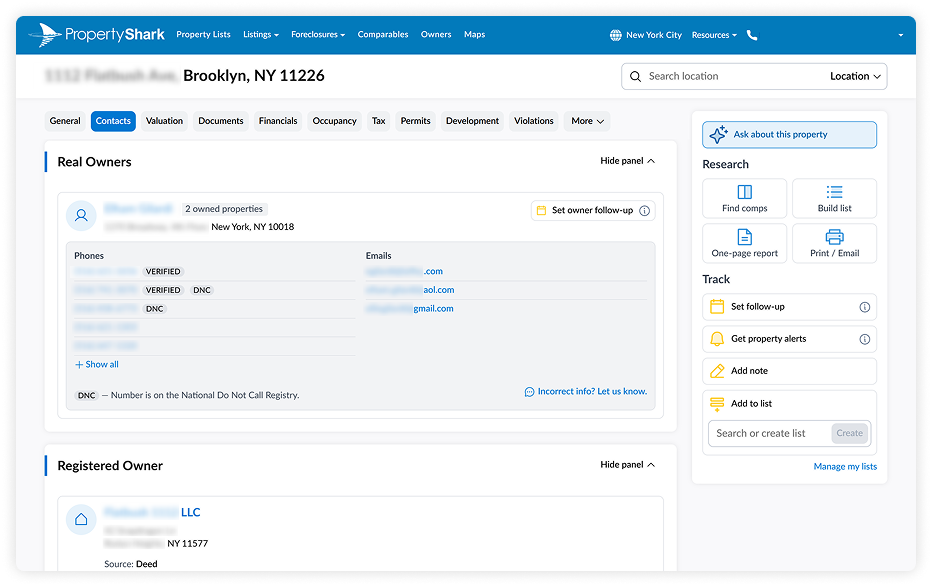
This is where paid research tools can make the process much easier. PropertyShark’s ownership tools support owner and company research, while the Real Owners and deep owner search features can help uncover the individuals and contact details behind LLC-owned properties in supported markets and plans. Coverage is especially broad for NYC properties.
Learn more about how to find LLC owners in NYC and what are the easiest ways to see past the LLC.
Absentee owners
Absentee owners are usually easiest to identify when the owner’s mailing address is different from the property address. That information may appear in assessor records, tax billing records or a detailed property report. In practical terms, this means the owner does not appear to live at the address in question, which can be an important signal for investors, brokers and researchers.
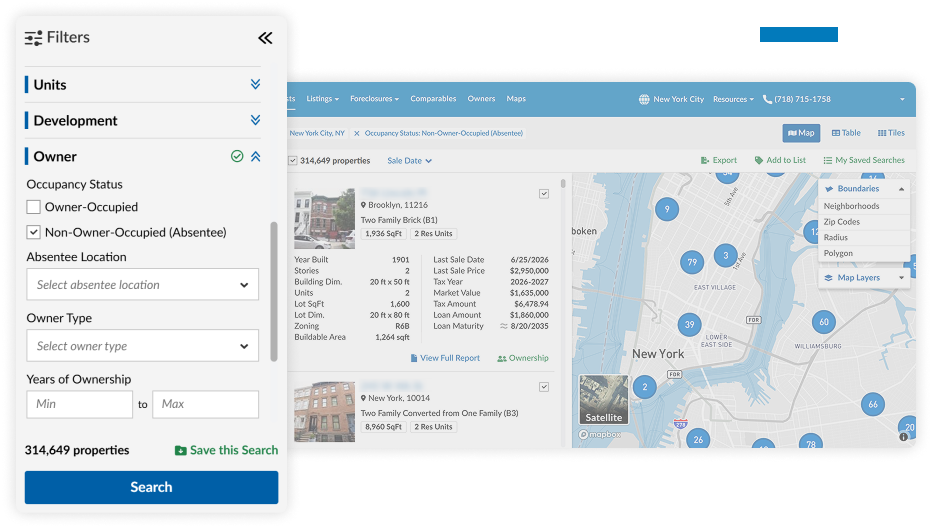
PropertyShark makes this type of search more efficient by allowing you to specifically filter for absentee-owner properties. You can further narrow results to in-state versus out-of-state absentee owners, as well as by individual versus corporate ownership.
Explore the easiest ways to find absentee property owner leads and turn them into deals.
Vacant or abandoned properties
Vacant or abandoned properties are usually not identified through a simple owner name search. Instead, they often have to be found through a combination of signals, such as tax delinquency, code enforcement activity, vacant building registries, landbank records or local vacant property programs.
The United States Department of Housing and Urban Development’s (HUD) USPS vacancy data can also be useful for identifying vacancy patterns at the neighborhood level. However, HUD vacancy data is grouped by census tract and does not provide a direct, property-by-property owner lookup beyond identifying whether an address is residential or associated with a business.
Once a likely vacant parcel has been identified, the next step is to use county recorder or assessor records and real estate platforms with ownership research functionalities like PropertyShark to verify who owns it.
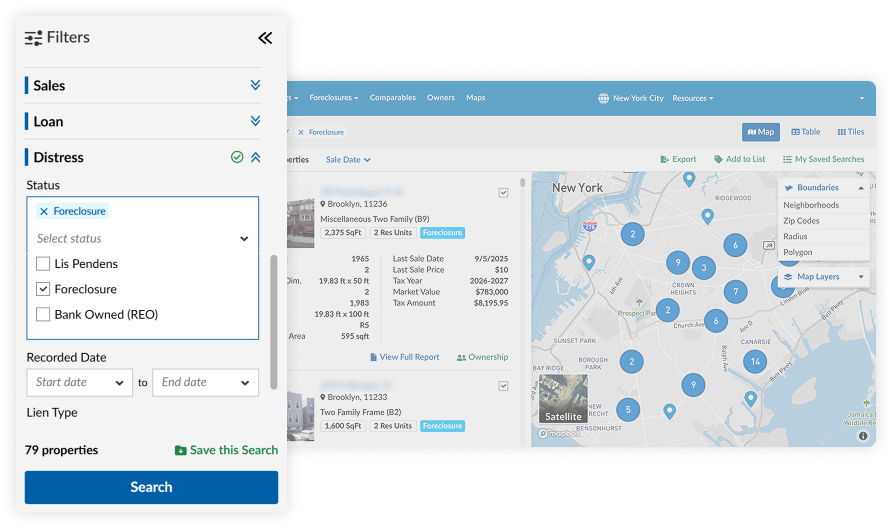
Read this comprehensive guide to learn how to find the owners of vacant or abandoned properties.
Commercial properties
Commercial properties are often owned through LLCs, partnerships or more layered ownership structures, which makes them harder to research than a typical single family home. In many cases, an address search alone will not be enough to identify the real owner or decision-maker behind the property.
Public records can still provide important details, including the recorded owner, deed history and mortgage details. However, a platform like PropertyShark can make the process more efficient by bringing together ownership, building, zoning, mortgage and portfolio data in one place. It is specifically built to support both residential and commercial property research, which is especially useful when ownership is more complex.
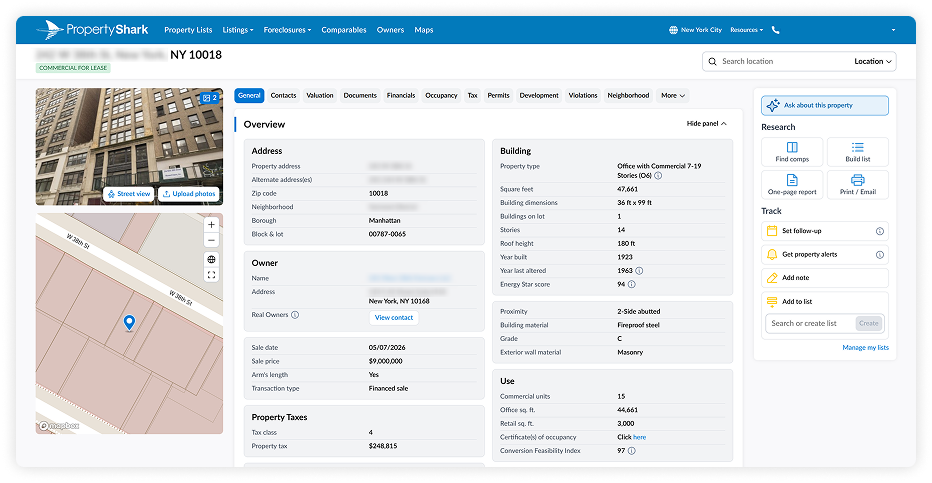
Learn all about how to find commercial property owners and streamline your outreach.
Land owners
When researching land ownership, map-based and parcel-based searches are often more effective than searching by address. That is because vacant land may not have a reliable street address or the address may not be enough to identify the correct parcel.
County parcel viewers are generally a strong starting point because they show parcel lines and basic ownership data tied to county assessor records. PropertyShark builds on that basic data by offering parcel maps and ownership overlays that help you quickly identify the correct tract before moving on to deed and owner research. This can save time and reduce confusion, especially when working with large lots, undeveloped land or parcels in rural areas.
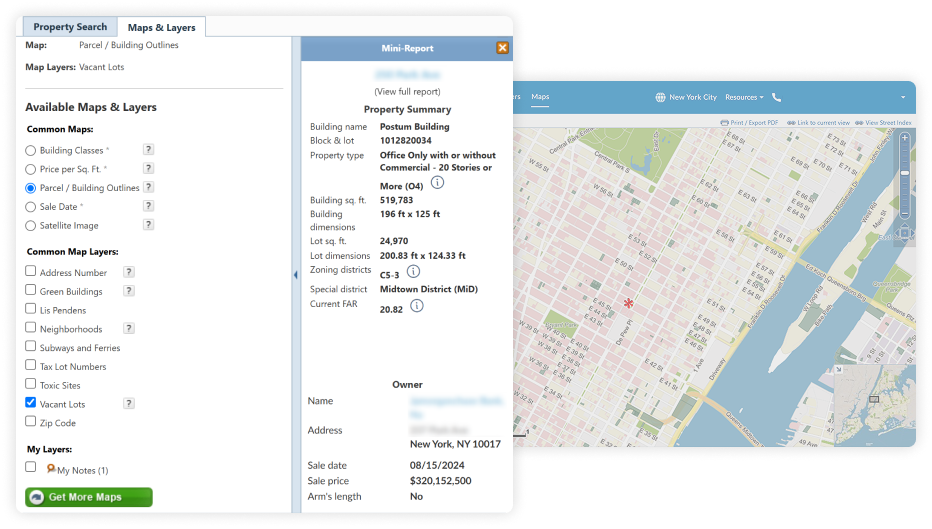
Learn more about this workflow in our practical guide on how to find out who owns land.
How to Look Up Property Owners on a Map
When map-based search is better than address search
A map-based search approach is the better choice when you don’t know the exact address, when the site is vacant or when you need to quickly compare adjacent parcels. On PropertyShark, property owner maps combine parcel boundaries with ownership data, so you can explore visually instead of requiring a precise address from the start.
Using parcel lines to identify the right property
Property maps can make owner research much easier by helping you identify the correct parcel, reduce guesswork and view ownership in context. Public parcel viewers usually show parcel lines and basic ownership data from county assessor records. By contrast, PropertyShark adds a more streamlined workflow by letting users find property owners by address or parcel ID on a map, click any parcel and open a mini report that displays the current owner along with key lot and building details.
The map tool also allows you to view nearby parcels, lot shapes, buildings, zoning details, taxes and other data overlays. This map layering approach makes it especially useful for brokers, investors and researchers comparing multiple properties in the same area without needing to switch between separate county sites.
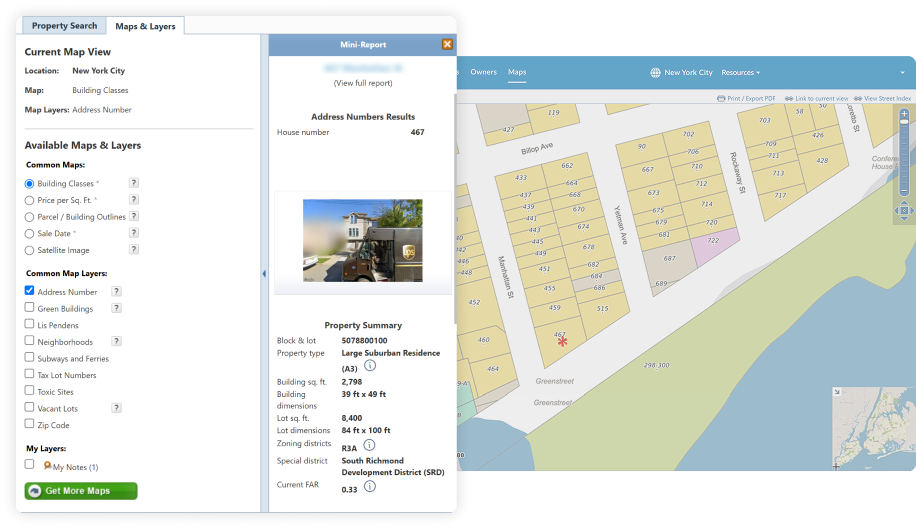
Read this article to learn more about how to see ownership details and parcel lines in a property owners map.
How to Find All Properties Owned by the Same Person or Company
Searching by owner name
Once you know the owner’s name or company, the next question is usually finding out what else do they own. With PropertyShark, you can search by owner name to view all properties associated with that entity using the deep owner search function simply by entering the owner’s name.
Getting a portfolio view
Portfolio overviews matters because one property rarely tells the whole story. PropertyShark’s deep owner search can return currently as well as previously held properties, along with any other affiliated properties, whether affiliated by owner name or through associated companies.
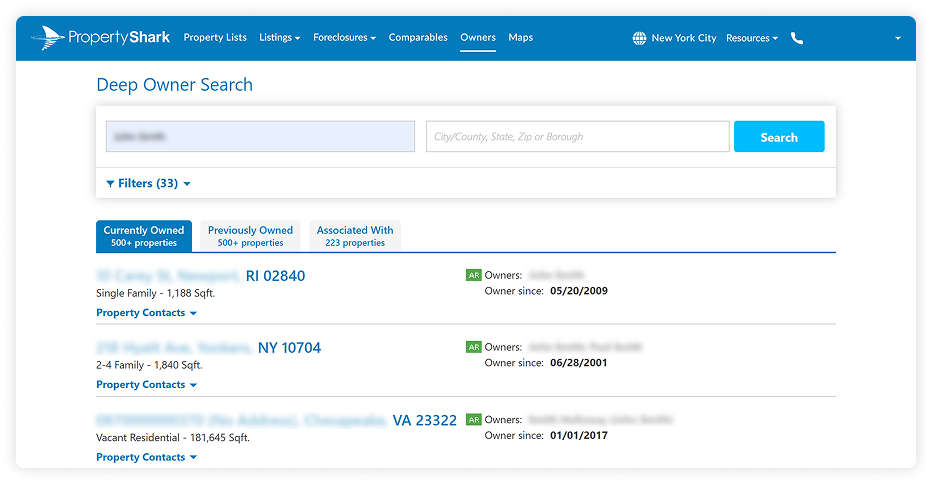
Tracking past and present ownership ties
Getting an overview of current and previous ownership ties is especially useful when ownership is spread across multiple entities or when you want to track separate property types like a house, a land parcel and a commercial asset back to one owner. With PropertyShark, you can leverage this output for outreach, analysis, acquisition targeting and portfolio research across property types and building classes, including land and multifamily assets.
For real estate professionals, portfolio visibility matters for prospecting and due diligence. It also helps identify repeat owners, assess lead strength and avoid researching one property at a time.

How to Find a Property Owner’s Phone Number or Contact Info
What public records usually include
Public property records are good at showing ownership and mailing information, but not direct contact information like phone numbers. County assessor systems commonly publish owner names, mailing addresses, APNs, assessed values and parcel data, while recorder systems focus on deeds and transaction documents.
Why a name and mailing address is often not enough
For outreach, a name and mailing address may be enough for direct mail, but not for fast contact, follow-up or verification. That is why real estate professionals often add skip tracing or people search tools after they look up homeowners by address in public records.
Using skip tracing and people search tools
Skip tracing is useful when trying to fill the contact data gap, but it requires verified contact information. With PropertyShark, you can find property owners’ phone numbers by searching the property address and reviewing the contacts tab in the full property report.
The deep owner search tool is also available for when a phone number is not immediately visible. With it, you can search by owner name, view all properties associated with a specific owner and access available contact details tied to the ownership profile. Data availability depends on plan and market.
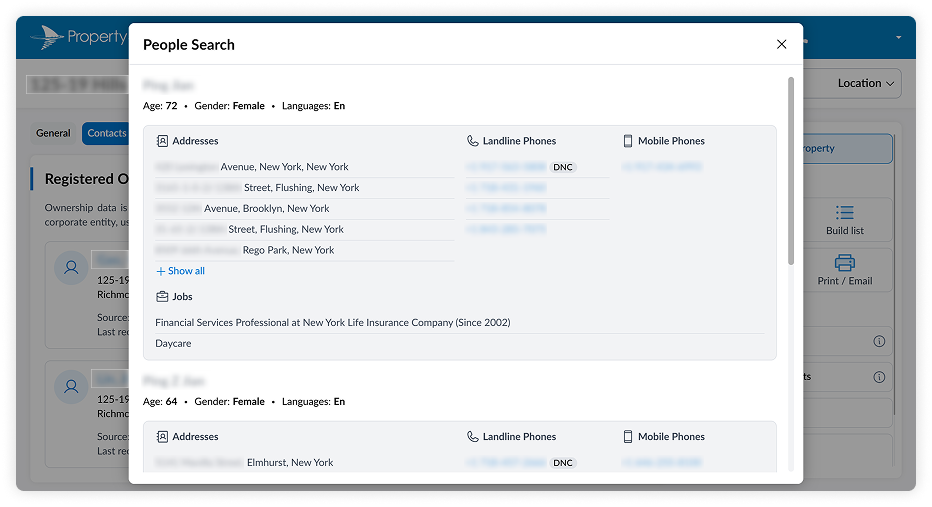
Explore the best ways to quickly find property owners’ phone numbers.
How to Look up Property Owners at Scale
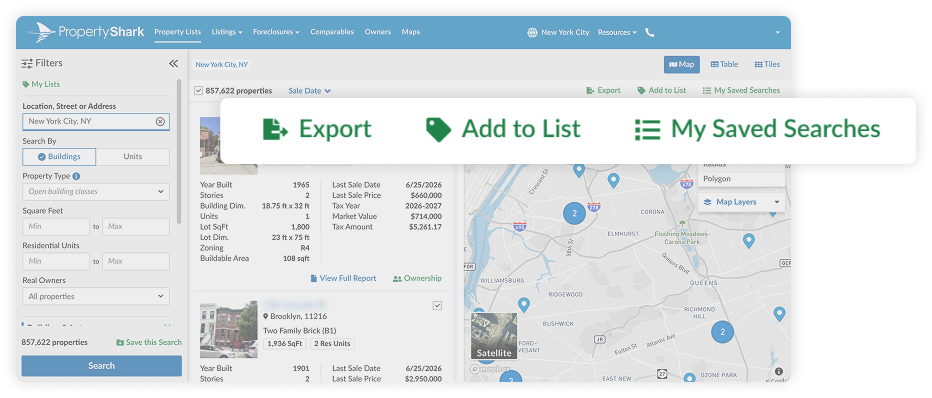
When researching property owners at scale, county-by-county searching can quickly become inefficient because every assessor, recorder and GIS system is structured differently. For larger projects, tools like PropertyShark make it easier to build property owner lists using shared filters such as location, ownership type, property condition and available ownership or contact data. This kind of workflow is especially useful when you need to research large volumes of properties at once rather than verify just one or two records manually.
List-building tools also make it easier to filter by absentee status, owner occupancy, owner type and location, which is especially helpful for marketing, canvassing and outreach. While manual research can still work for a small number of properties, PropertyShark becomes much more efficient when you need owner data across multiple ZIP codes, neighborhoods or property classes. Instead of repeated manual assessor, recorder- and GIS searches, PropertyShark combines property searches, filtering, ownership research, mapping and exports, all in one place.
Conclusion
If you want to know how to look up property owners, start with assessor, recorder, tax and GIS records, then move into deeper owner research if the property is hard to trace. For one-off lookups, public records are usually enough. For repeated prospecting, portfolio research, map-driven analyses and contact discovery, a platform like PropertyShark shortens the process by bringing all these records and workflows together in one place.
FAQs
How to look up property owners for free?
Use the county assessor or property appraiser first, then the county recorder or clerk for deed history and finally the GIS parcel viewer to verify the correct lot. Many county assessor systems publish the owner name, mailing address, parcel ID and parcel map information, making them the best free starting point.
Can you search property owners by address?
Yes, many assessor, appraiser, recorder and commercial owner lookup platforms support address searches, although the exact search fields vary by county. On PropertyShark, you can search by address, owner name or parcel ID to access the property report.
Can you search by owner name or company name?
Yes, public deed indexes often allow name-based searches and state business entity databases allow you to search for companies and LLCs. PropertyShark also supports searching by owner and company name to find related properties and ownership records.
What if the property is owned by an LLC?
If the property is owned by an LLC, start with the deed to confirm the entity’s name, then search the relevant secretary of state database for the LLC’s filing details. Public information varies by state, so if you need more than the registered entity’s record, you may need deeper ownership research tools, title work or market-specific real owner products.
Can you find all properties owned by one person?
Sometimes, yes. If you’re using public sources, you may need to search deed records and assessor rolls repeatedly by owner name, but tools such as PropertyShark’s deep owner search are built specifically to return properties currently or previously held by the same owner and any affiliated entities.
How can you find a property owner’s phone number?
Phone numbers are usually not the core output of assessor or recorder systems, so professionals often use skip tracing or people search tools after identifying the owner. PropertyShark’s People Search tool can return available phone numbers, emails, social profiles and other contact details from the property report workflow, with availability depending on plan and market.
Is PropertyShark good for owner research?
Yes, PropertyShark is especially helpful when you need one place for ownership, deed, tax, zoning, mortgage, map, portfolio and contact research. PropertyShark is a property research platform with owner and contact data, title documents, maps, list-building and ownership tools, with coverage depth depending on local record availability.
Access comprehensive property data and ownership information with intuitive research tools.


Laura Pop-Badiu is a Senior Creative Writer at PropertyShark, with a degree in Journalism and a background in both hospitality and real estate. Laura is a certified bookworm with a genuine passion for the written word and a keen interest in the real estate market, having previously written for Yardi's RentCafe, CoworkingCafe and CoworkingMag. Her work has been featured in major publications like The New York Times, Forbes, NBC News, The Business Journals, Chicago Tribune, MSN and Yahoo! Finance, among others.
Recent Reports
Atherton Breaks $10M Median as 11 States Set New Price Records
2026 brought record price peaks to 11 states, including the first ever eight-figure median sale price with Atherton’s dramatic surge back to #1. Meanwhile, California’s presence continued to shrink with the pullback of the Bay Area, although it remained home to more than half of the country’s top zips, while the New York metro supplied one quarter, its strongest presence yet.

NYC Homeownership by the Numbers: How Household Type, Gender & Age Shape Who Owns in Every Neighborhood
In a city where homeownership is dominated by married-couple families, Manhattan stands as the only borough led by nonfamily owners. At the same time, residents younger than 35 make up less than one tenth of the ownership pool and female-led family households outnumber male-led families across 91% of NYC neighborhoods.

Prices Rise in 32 of NYC’s Leading Neighborhoods as City and Manhattan Hit Record Highs
Q2 2026 saw NYC and Manhattan reach historic highs, with Brooklyn and Queens marking close to new records as well. Meanwhile, Hudson Yards remained at the top, Central Midtown posted its highest price ever and Carroll Gardens marked its third consecutive quarter over $2 million